A now-fixed flaw in the ChatGPT app for Mac allowed access to conversations
IA en un minuto newsroom · Editor: Jon Elgezabal
In 30 seconds
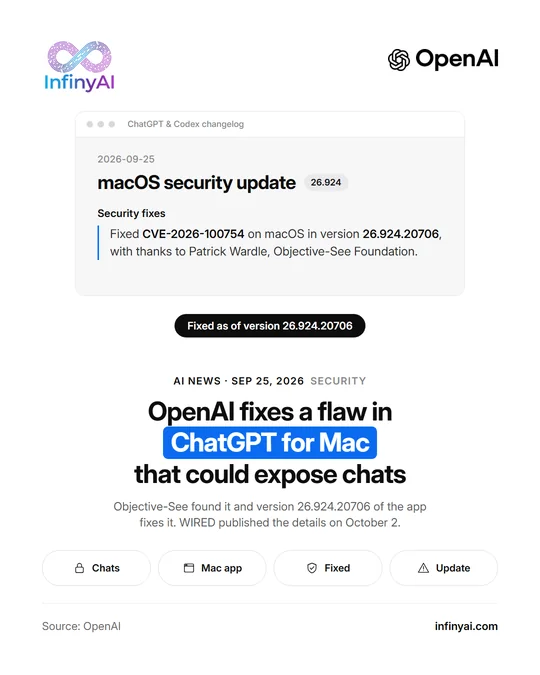
Version 26.924.20706 of ChatGPT for macOS, released by OpenAI on September 25, closes CVE-2026-100754, a flaw found by Patrick Wardle. One trusted part of the app, which interprets scripts, accepted outside commands and could have let an attacker take over ChatGPT and read the chat history. According to Wardle, exploiting it was trivial, and OpenAI admits it needs to move faster.
On September 25, OpenAI fixed a vulnerability in the ChatGPT app for macOS. Its official changelog says that version 26.924.20706 fixes CVE-2026-100754, found by Patrick Wardle of the Objective-See Foundation. On October 2, WIRED published the details.
According to WIRED, the Mac app has several components that talk to each other and check digital signatures to make sure each request comes from OpenAI and not from outside software. The researchers found that one of those trusted components, a script interpreter, could accept commands and pass them to the main ChatGPT process. An attacker could have taken control of ChatGPT on the victim's computer, with access to the chat history and other app data, and made it run commands on their behalf, for example in the browser.
Wardle says exploiting it was "insanely trivial". OpenAI told WIRED that it keeps improving its security practices but recognizes the need to move faster. Wardle has also sent OpenAI another finding, related to the integration between ChatGPT and Dots, the company's new always-on agent, and OpenAI is reviewing it.
Why it matters · analysis and opinion
Check which version of ChatGPT you have on your Mac: the flaw is fixed, but only for those who have updated. The hole was not in the AI but in the trust between the parts of the app itself, and it opened the door to the chat history and to running commands in the browser on the user's behalf. The researcher describing it as extremely easy to exploit and OpenAI admitting it needs to move faster says a lot about the moment: desktop AI apps are getting more and more permissions and security is lagging behind. In a company, the sensible thing is to turn on automatic updates on every computer and review what permissions each installed assistant has.
Official source: OpenAI · Written with the help of AI: how we make the news
What does it mean for your business? · analysis and opinion
If anyone in your company uses ChatGPT on a Mac, the first step is the cheapest one: check that everyone has the version fixed on 25 September or a later one. The flaw has been fixed, but only for those who have updated, and in teams without someone dedicated to IT, updates can sit pending without anyone noticing.
The case carries a lesson that goes beyond this flaw. Desktop AI apps keep the conversation history and, more and more, can act on the computer or in the browser on behalf of whoever uses them. In our view, that makes them as sensitive as email: they should update themselves, nobody should paste passwords or unnecessary customer data into them, and old conversations that are no longer useful should be deleted.
The risk of doing nothing is small if you update, but it is not zero: the researcher has sent OpenAI another finding, about Dots, its always-on agent, and it is still being reviewed. Our advice is to wait until that is cleared up before giving that agent permanent access to work computers.