IA en un minutoNewsBusiness and products
Three major US book publishers are quietly using AI, WIRED reports
IA en un minuto newsroom · Editor: Jon Elgezabal
In 30 seconds
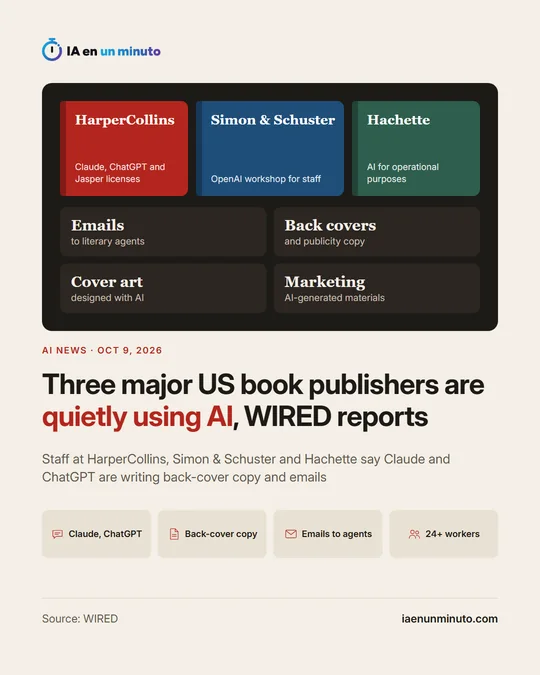
Staff at HarperCollins, Simon & Schuster and Hachette tell WIRED, without giving their names, that their employers rely on Claude and ChatGPT with no public notice and no permission from authors. The models turn out emails for literary agents, back-cover text, cover designs and marketing pieces. Simon & Schuster says nobody is required to use them, and Hachette restricts them to operational work.
WIRED reported on Friday, October 9, that at least three of the Big Five US book publishers, HarperCollins, Simon & Schuster and Hachette, have been incorporating AI tools into their work without public disclosures or author consent. The magazine bases this on interviews with more than two dozen workers, all of whom spoke anonymously to avoid jeopardizing their jobs.
According to those accounts, the publishers use models such as Claude and ChatGPT to email literary agents, write publicity and back-cover copy, design cover art and generate marketing materials, often at the direction of their executives. One of the most common uses is publicity copy, the text readers find on Amazon, on Goodreads or on the back cover of a book.
At HarperCollins, according to one employee, senior leaders bought Claude licenses from Anthropic months ago and dozens of junior and senior staff members were made "AI Champions", tasked with finding use cases in monthly sessions. Staffers say the publisher also has licenses for ChatGPT and for Jasper, an agentic marketing platform. HarperCollins did not respond to WIRED's requests for comment.
At Simon & Schuster, employees attended a workshop with OpenAI representatives months ago, and one of the recommendations was to use ChatGPT to write emails to literary agents. Wibke Grutjen, the publisher's global chief marketing and communications officer, says employees across all functions have access to a limited number of AI tools, that using them is not mandatory and that the company prohibits any tool it has not vetted and approved. A Hachette spokesperson says the company supports AI tools "for operational purposes", when they help its authors' books reach more readers, but not creative uses, including communicating with authors and partners.
All of the literary agents WIRED spoke with fear that publishers might paste text from their authors' manuscripts into these models, for example to generate rejection letters or publicity descriptions. One of them says they already add clauses to their contracts that forbid it.
At Simon & Schuster, word also spread among workers in the past few weeks that the company was running an experimental trial with Skan AI, a workflow-analysis tool. Employees began gathering signatures on an open letter to their CEO, Greg Greeley, asking that neither that software nor anything similar be brought into their work. On October 6, New York magazine's Book Gossip newsletter published news of the letter, and on the same day Greeley sent staff a memo: he confirmed that the company has been exploring Skan AI's Blueprint product and said that no decision has been made to use it.
These are anonymous accounts gathered by WIRED, not an announcement from the publishers.
Why it matters · analysis and opinion
The report does not describe books written by machines but something more everyday: AI comes in through the surrounding tasks, the email, the sales copy, the cover, and does so without anyone saying it outside. That is the heart of the matter, more than the tool itself: authors and agents hand over a manuscript without knowing which programs it will pass through. The reaction already has a practical shape, with agents protecting texts by contract and staff gathering signatures. Any company that works with material belonging to others, whether a manuscript, a design or a client's data, can draw the same lesson: decide in writing which tools are used and with what content, and say so before someone else does. All of this with one caution: these are anonymous accounts, and two of the publishers give a more limited version of their use.
Source: WIRED · Written with the help of AI: how we make the news