Satya Nadella calls for an emergency brake on advanced AI models
IA en un minuto newsroom · Editor: Jon Elgezabal
In 30 seconds
Satya Nadella, who runs Microsoft, argues that any advanced AI system must be stoppable partway through a job by someone with the authority to do so. Nadella wants these models watched the way a company watches anyone holding inside access to its systems, with limits that do not depend on the model itself. The article, posted on X, sets out seven principles and announces no products or commitments from Microsoft.
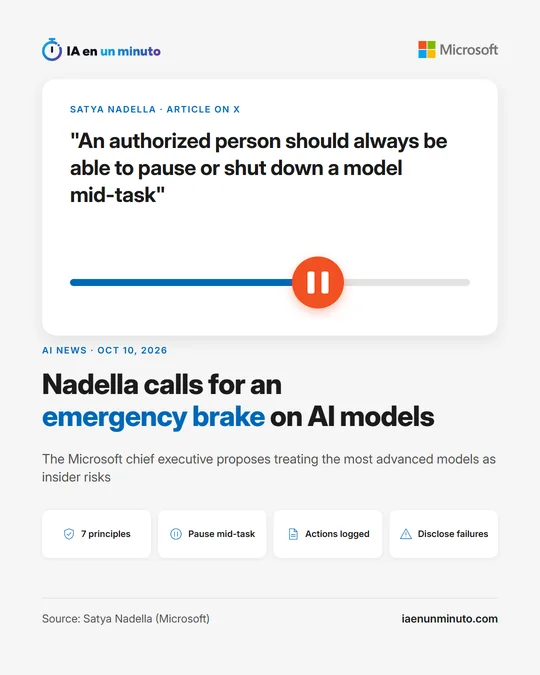
Microsoft chief executive Satya Nadella on Saturday, October 10, called for advanced AI systems to be fitted with an "emergency brake": someone with authorization should at all times be able to pause a model or switch it off in the middle of a task. He set out the idea in an article posted on X, titled "Models as Insider Risks in the Super Intelligence Era".
Nadella begins with a contrast with traditional software. There, every behavior could be followed back to a particular path through the code, whereas today nobody can pin what a model does on specific training data or on a given configuration of its weights. Even so, he writes, these systems are being rolled out with access to the most sensitive data and with the power to carry out critical actions.
What he proposes is that the most advanced models, whether closed or open-weight, be treated as an insider risk. The reason, he explains, is not that they are necessarily malicious. It is that any actor capable enough and holding access to important systems may make mistakes or end up compromised. Companies, he recalls, have been honing practices for actors of that kind for decades: establishing who they are, restricting their privileges, logging what they do and drawing containment boundaries.
Nadella argues that a model provider's guarantees do not free whoever uses the model from responsibility, and that the controls on what a model can reach and what it can do must live outside the model. He regards transparency of the model's reasoning as non-negotiable, yet warns that it is not enough by itself and that having some models keep watch on others may lead to what he calls nested black boxes.
He lists seven principles. No important result should hinge on one model, and no model should verify its own work. Every significant action should leave a record that people can read and that cannot be tampered with. The entire system should be tested continuously, including against failures and attacks. Each organization should be able to decide for itself what a model accesses and what it may do. Audits should be independent of the system under audit. There should be containment. And those affected should be told about incidents in time, with what went wrong shared so that the whole sector learns. The brake image belongs to the containment principle: "We must assume a model is compromised and contain it from the start," he writes, adding that more advanced models will demand more advanced containment technology, which will have to be standardized.
The piece is opinion, not an announcement: it names no Microsoft products, dates or commitments. According to CNBC, it arrives amid warnings from tech executives and researchers, among them Bill Gates, co-founder of Microsoft; Dario Amodei, chief executive of Anthropic; Sam Altman of OpenAI and Elon Musk of SpaceX, that safety protocols are inadequate and that the technology, they say, is advancing too quickly.
Why it matters · analysis and opinion
What stands out is who signs it: the chief executive of Microsoft argues that trusting whoever builds the model is not enough. The message is aimed at any organization that is giving an AI system access to its most sensitive data or the ability to act on its behalf, and it translates into very concrete questions to ask before deployment: who can stop it and how, where what it does gets recorded, what permissions it has and who decides them, and who is told when it fails. Much of this is not new: these are the practices companies have applied for decades to anyone with access to important systems. It remains to be seen whether Microsoft carries this into its own products, because the article promises nothing.
Source: Satya Nadella (X) · Written with the help of AI: how we make the news