Anthropic explains on its blog how it redesigned its source control system
IA en un minuto newsroom · Editor: Jon Elgezabal
In 30 seconds
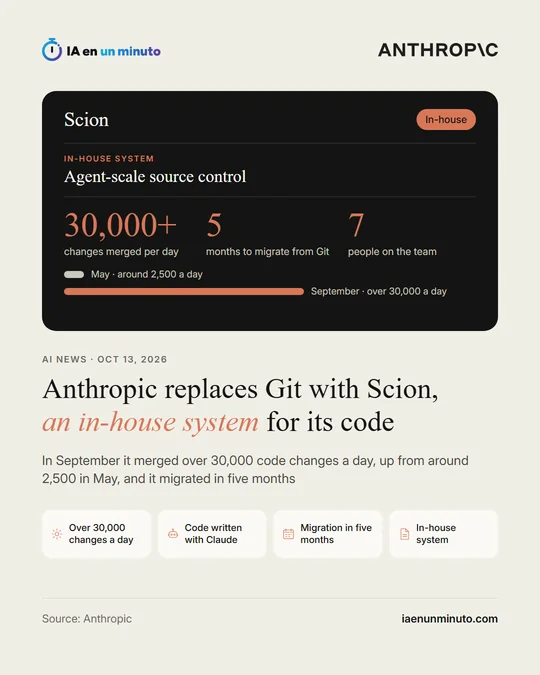
Anthropic no longer keeps its code in Git: over five months it moved to Scion, a homegrown version control system. In May it was taking in about 2,500 changes daily and by September the count had passed 30,000, a pace it puts down to the code Claude writes. Scion leaves the heavy lifting to the server, needs infrastructure 200 times smaller than before and stays in-house.
Anthropic has stopped using Git, the standard system for storing and tracking changes to code, in its monorepo (the single large repository where it keeps its code). In its place it has built Scion, a version control system of its own, and the move was finished in five months. The company tells the story on its engineering blog, in a post dated October 13.
The reason is the pace at which Claude, its AI model, writes code. Back in May 2026, about 2,500 code changes a day were being merged at Anthropic on average (changes that become part of the shared code). By September the figure was above 30,000 a day. The company says writing code has stopped being its bottleneck, that the bottleneck is now the tooling designed for the pace of people (source control, builds and automated testing), and that it does not expect the growth to ease any time soon.
Git hands every user a full copy of the repository so that work can continue offline. Anthropic explains that almost all of its users are now AI agents and automated jobs, which are connected at all times. Its main branch carries almost 100 GB of history, and the code is checked out on the order of 25 million times a day for continuous integration alone (the automated tests run on the code). At one point it kept several hundred internal Git mirrors running to bear that load. In Scion the server does nearly all of the work, and each job requests only the directories it needs. To design it, the company says it drew on what Google learned with Piper and Meta with Sapling, two systems for very large repositories.
According to Anthropic, Scion's infrastructure is 200 times smaller in processor and memory terms than what its Git mirrors required, and testing and research jobs now get the code in seconds where it used to take minutes. For continuous integration alone, the company puts the gain at 25% of processor capacity.
It was built by a team of seven, which in those five months also produced Antique, the internal tool for reviewing code, and half a dozen related systems, all while the amount of code merged each day grew tenfold. The company says a project like this would once have needed years and far more engineers. As an example, it recounts that an internal version of Claude Mythos Preview, one of its models, rewrote a component the team had mostly written by hand, and the result needed 20 times less memory and ran 4 times faster.
Anthropic states that every engineer on the project now rates Claude as a better writer of code than they are. It adds that their work is worth no less, but is changing. They supply the design and the underlying decisions and still review each change, although they look at its intent and not at every line, and very often their role was to tell Claude no.
Scion is for internal use. Anthropic says it is no substitute for Git in general use, that it only makes sense for enormous repositories and that offering it to other organizations would be hard, because it also means replacing code review, code search and automated testing. It also acknowledges that its capacity to spend tokens internally goes far beyond what another business would realistically choose to spend. It expects problems of this kind to become more common over the coming 6 to 12 months and wants to work with GitHub, GitLab and the open-source community.
Why it matters · analysis and opinion
Git has been the base on which half the world programs for almost two decades, and a company dropping it from its main repository says less about Git than about who is writing the code now. Development tools were designed for people who work offline and at a human pace; with agents that never stop, the seams split in places nobody was watching. Anthropic warns that its case is unusual and that its system is of no use to almost anyone else. The useful reading for an ordinary team is a different one: before adding coding agents, check whether the automated tests, the review process and the repository will hold up under more changes than pass through them today. And the role of whoever reviews is shifting: less reading of lines, more deciding what gets accepted and what does not.
Official source: Anthropic · Written with the help of AI: how we make the news