Skip to content
by InfinyAI ES

Issue no. 2 · Friday October 9, 2026

AI this week

From October 2 to October 8, 2026 · 7 stories in 7 minutes

A week of models for everyone, and of rules. OpenAI has brought GPT-6 to every ChatGPT user, including those on the free plan, and Anthropic has launched Claude Haiku 5.5, its cheapest and fastest small model so far. Meanwhile, the White House has set up a committee to coordinate AI, OpenAI is preparing watermarks for ChatGPT text in the EU and the Spanish government's AI advisory council is calling for fair taxation of tech companies. Here is what matters, one minute at a time.

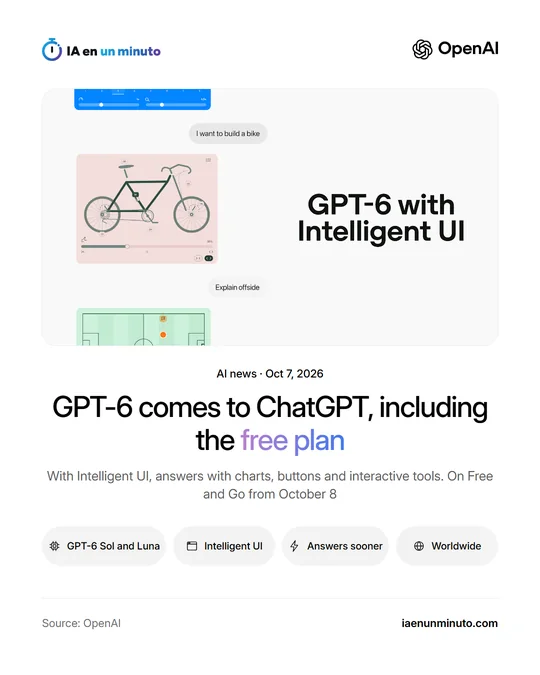
IA en un minuto image with the OpenAI logo, a screenshot of GPT-6 with Intelligent UI and the headline about GPT-6 reaching ChatGPT, including the free plan, with icons for GPT-6 Sol and Luna, Intelligent UI, faster answers and worldwide.

Story of the week

Models

OpenAI brings GPT-6 to all ChatGPT users, including those on the free plan

ChatGPT now runs on GPT-6 for anyone paying for Plus, Pro, Business or Enterprise, and from October 8 on Free and Go as well, in every country. Paid plans use GPT-6 Sol; Free and Go use GPT-6 Luna. Its headline change, Intelligent UI, lets an answer arrive with maps, charts, forms or small tools that can be used without leaving the chat.

Why it matters

GPT-6 is no longer just for paying users: it reaches all of ChatGPT with visual, interactive answers inside the chat.

Read the story

Official source: OpenAI

Models

Anthropic launches Claude Haiku 5.5, its cheapest and fastest small model yet

Haiku 5.5 is Anthropic's new small model: on average it comes in around 75% cheaper than Haiku 4.5, answers faster than any other model from the company at standard speed and lets users choose the effort level. Sonnet 5.5 is also getting cheaper, because reading from its cache now costs half as much. This week, Max and Team plans start receiving a monthly balance for the API, up to $500 on Team.

Why it matters

Anthropic is making its small model cheaper for repetitive, high-volume tasks, and is also lowering the cost of using Sonnet 5.5 with agents.

Read the story

Official source: Anthropic

Trump creates the "Superintelligence Force", a White House committee to coordinate AI in the US

Donald Trump used Truth Social to unveil the Superintelligence Force, a committee that will sit inside the White House and coordinate federal work on AI. Director of National Intelligence Jay Clayton will lead it, with Andrew Ferguson, Emil Michael and Scott Kupor serving as vice chairs. The committee will answer to Trump himself and to Susie Wiles, his chief of staff.

Why it matters

AI policy in the United States will now be coordinated from the White House, which will also deal with AI companies.

OpenAI will add invisible watermarks to ChatGPT and Codex text in the EU to comply with the AI Act

To meet the AI Act, OpenAI will put marks people cannot see into text that ChatGPT and Codex produce for users in the European Union, starting in the coming weeks. On the API, any customer in the world can already switch them on for some models, though they come turned off. Only approved researchers and expert organizations will get the detector, which in OpenAI tests fell from 92% to 66% when 10% of words were swapped.

Why it matters

In its tests, replacing 10% of words with synonyms reduced detection from about 92% to 66%: the watermark helps, but it is not foolproof.

Read the story

Official source: OpenAI

A researcher finds the same security flaw in AI agents from Google, JPMorgan and the French government

Google, JPMorgan Chase, Weaviate, the French DINUM and the city of Tangerang in Indonesia all had the same hole in their MCP servers, according to Syed Anas Mohiuddin. All it took was a hidden order inside some content: the first agent passed it on and the second obeyed, because it trusts the first. Each organization confirmed it and has already patched it.

Why it matters

MCP is the standard AI agents use to connect to tools and data, so this is a design flaw, not one company's bug.

The Pentagon confirms to the BBC that it no longer uses Anthropic's AI tools

An official has told the BBC that the US Department of Defense has stopped working with Anthropic's AI tools. Pete Hegseth labeled the company a risk to the supply chain in February after it refused to strip the safeguards from Claude. Several sources say Claude was still running last week inside Maven Smart System, the platform operated by Palantir.

Why it matters

Claude was still embedded in Maven Smart System, the Pentagon's main intelligence platform, after the August deadline.

Spanish government's AI advisory council calls for "fair taxation" of tech companies and for assessing AI that may affect minors before it is deployed

The international council advising the Spanish government on AI, led by Manuel Castells, wants tech companies to face fair taxation. The manifesto also wants AI that could reach minors to pass an independent review before deployment. Minister Óscar López says the government aims to turn those ideas into laws if it wins re-election on November 29.

Why it matters

It sets out the ideas the government says it wants to turn into AI laws if it stays in office after the election.

What to watch

  • Large 4, Mistral's one-trillion-parameter model, is in preview for now. Read the story
  • Cisco has announced that Claude agents are coming soon to Webex, its collaboration suite. Read the story
  • Norway will propose a temporary ban on AI glasses in parks, schools and other public places. Read the story
  • OpenAI will test ads with images in ChatGPT in October, in the US only. Read the story
  • Apple will tighten the Full Disk Access permission in macOS because of the risk from AI agents. Read the story

Also this week

Other issues

Get it in your inbox: every day or every Friday

The stories that matter, each one in a minute. With the source for every one.

Choose one or both:

Sign up and you are in: the daily arrives every night and the weekly on Friday mornings. You can unsubscribe from any email.