IA en un minutoNewsBusiness and products
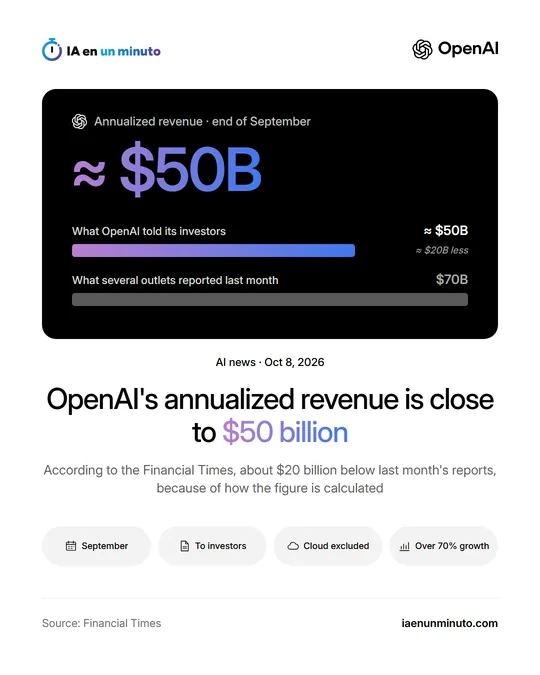
OpenAI's annualized revenue is close to $50 billion, about $20 billion below earlier reports, according to the FT
IA en un minuto newsroom · Editor: Jon Elgezabal
In 30 seconds
The accounts OpenAI has shown its investors put its yearly revenue run rate near $50 billion, according to the Financial Times. That is well short of the $70 billion that circulated last month, a number inflated by trying to line it up with Anthropic's. The key is that Anthropic counts what it sells through AWS and Google Cloud, whereas OpenAI leaves those sales out.
OpenAI has told its investors that its annualized revenue (the revenue from a short period, projected over a full year) was approaching $50 billion at the end of September, according to financial documents reviewed by the Financial Times. That is about $20 billion below the $70 billion that several media outlets reported last month based on information shared with investors.
According to the FT, the difference comes down to how the figure is calculated. Anthropic, its rival, includes in its annualized revenue the sales it makes through cloud partners such as AWS and Google Cloud, while OpenAI does not count them in its own figure.
The $70 billion figure came from investors trying to compare the two companies directly. Earlier attempts to adjust OpenAI's numbers led to reports that put its annualized revenue at $40 billion in August, and the company told investors that its revenue had grown more than 70%. According to Yahoo Finance, investors applied that growth to the $40 billion and arrived at $70 billion.
Yahoo Finance adds that, at $50 billion, OpenAI's annualized revenue would fall below Anthropic's $65 billion, although the two companies do not calculate it the same way.
Annualized revenue serves as a key indicator of demand for artificial intelligence and influences the sector's infrastructure spending decisions.
Why it matters · analysis and opinion
The figure says as much about method as about business. Annualized revenue has no common definition and each company decides what goes into it, so comparing two rivals that count sales through the big cloud providers differently can lead to conclusions far from reality, as happened here. Anyone following this market, whether investor, analyst or customer, has reason to ask how a figure was calculated before using it in a comparison. For a company choosing an AI provider, each lab's revenue says little about which tool suits it: product, price and support matter more. Until figures are published on the same basis, any ranking between the two should be read with caution.
Source: Investing.com · Written with the help of AI: how we make the news