IA en un minutoNewsBusiness and products
Anthropic commits $150 million over three years to the US Genesis Mission
IA en un minuto newsroom · Editor: Jon Elgezabal
In 30 seconds
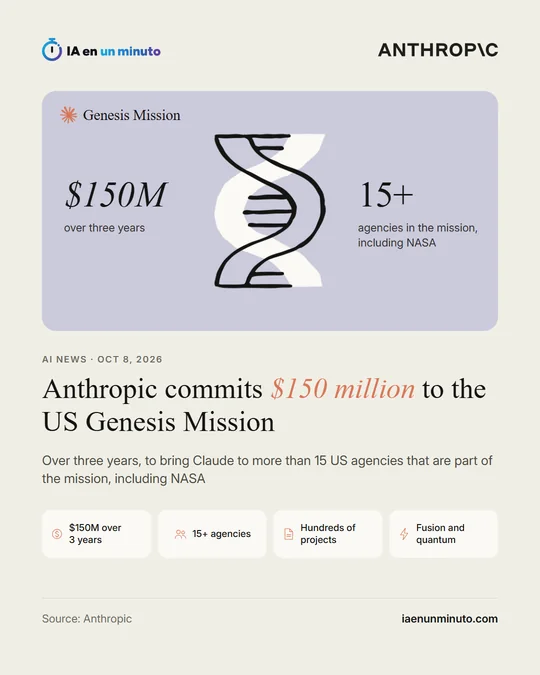
Anthropic will put $150 million into the Genesis Mission, a US government push to speed up science with artificial intelligence, over a three-year period. That money will bring Claude to more than 15 agencies, such as NASA, and to several hundred projects, along with training for their scientists. It extends the partnership it struck with the Department of Energy in December 2025.
Anthropic has committed $150 million over three years to the Genesis Mission, the federal initiative in the United States to accelerate scientific and technological discovery with artificial intelligence. It announced the commitment on October 8 at the "Science: A New Golden Age" summit, hosted in Washington, DC, by the White House Office of Science and Technology Policy.
The funding will go toward making Claude available to more than 15 agencies that are part of the mission, including NASA, the National Institutes of Health (NIH) and the National Science Foundation (NSF).
Over these three years, Anthropic will provide Claude, Claude Code (its coding tool) and API credits to several hundred research projects in the mission. It will also work with agencies and national laboratories on the administration's top science priorities, such as fusion energy and quantum computing, provide training and technical support to scientists on the projects, and help agencies new to the mission get their first projects running. The announcement does not detail how the money will be divided or which projects will get access.
It is another step in the partnership Anthropic announced in December 2025 with the US Department of Energy (DOE) for the Genesis Mission, then described as the department's initiative to use AI to cement America's leadership in science. That multi-year partnership focused on three areas (American energy dominance, the biological and life sciences, and scientific productivity) and had the potential to affect the work of all 17 national laboratories. Anthropic says it has since worked with the DOE to bring Claude to scientists across those laboratories. Earlier, it had developed a nuclear risk classifier with the National Nuclear Security Administration and rolled out Claude at Lawrence Livermore National Laboratory.
Earlier this year, Anthropic launched Claude Science, an AI workbench that brings together the tools and packages researchers use most, and opened 10,000 free and discounted Claude seats for academic scientists. It also expanded its AI for Science program, which gives credits to researchers on high-impact projects, and began a research preview of the Model Hardware Standard, a shared specification for AI agents to operate lab instruments safely.
Why it matters · analysis and opinion
Publicly funded science has become another arena of competition among the big artificial intelligence companies. Putting models in the hands of researchers at federal agencies, with credits, training and support included, builds habits, and teams that learn to work with Claude will tend to stay with it when paid contracts come along. For the government, the appeal is speeding up costly, slow fields such as fusion or quantum computing without paying up front. The practical side remains to be seen: Anthropic does not explain how the money is split or how projects are chosen, and the real value will depend on whether those scientists achieve results they would not have reached without the model.
Official source: Anthropic · Written with the help of AI: how we make the news