OpenAI exposes a Russian operation that used ChatGPT and reached schools in Peru and Ecuador
IA en un minuto newsroom · Editor: Jon Elgezabal
In 30 seconds
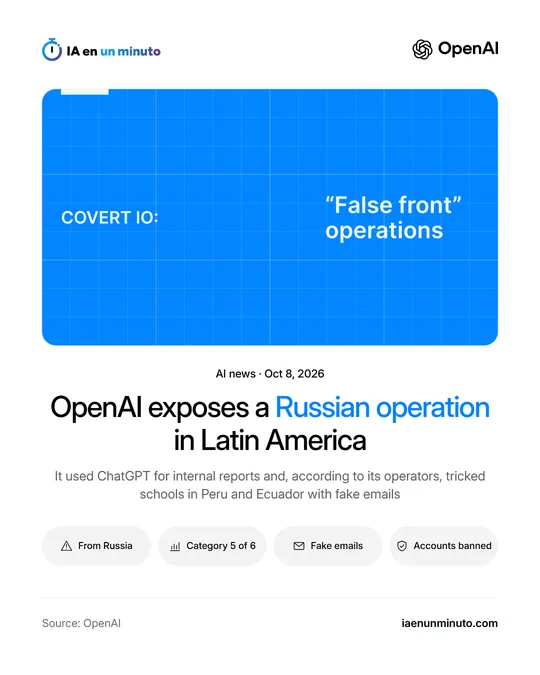
OpenAI has shut down ChatGPT accounts run from Russia by a covert campaign in Latin America, largely aimed at Ukraine, which it calls Dark Clark. The operators barely used it to produce propaganda and relied on it instead for internal paperwork, while running a fake think tank whose local staff, according to OpenAI, did not know who they worked for. With fake emails they got, by their own account, schools in Peru and Ecuador to hold events.
OpenAI has banned a cluster of ChatGPT accounts originating in Russia that were part of a covert influence operation targeting Latin America. The company has named it "Dark Clark" and places it in Category 5 of the Breakout Scale, which rates these operations from 1 to 6. It is the first operation in that category that OpenAI has disrupted since it began publishing these reports.
According to OpenAI, much of the activity aimed to damage Ukraine's reputation in the region, and some of it aimed to influence local politics, especially in Argentina and Bolivia. Most of the operators prompted in Russian; one prompted in Spanish but also appeared to be located in Russia. They accessed ChatGPT through VPNs, because OpenAI does not allow access from Russia, and mainly used it to draft internal reports on their campaigns for an unknown superior. In most cases, OpenAI did not see them using it to create the content of the campaigns.
They also reported on a self-described research platform in Latin America, the Social Research Center, which they ran through a fake persona, "Mia Clark", hence the name of the operation. According to OpenAI, the available evidence indicates that its employees in the region were not aware that they were working for a Russian group. On its website, the center says it focuses on the Indian diaspora in Latin America, and OpenAI found more than 60 articles there, the great majority of them original.
In their reports, the operators claimed credit for fake stories spread across the region. Some of them had already been attributed to a Russian entity known as "Politology" or "La Compania", a reported successor to the Wagner Group.
The most striking case took place in Peru. In May this year, according to their own reports, the operators created a fake email address posing as the Regional Directorate of Education in Lima and asked schools to hold events dedicated to Ukraine on May 21, the Day of Cultural and Linguistic Diversity, with references to Stepan Bandera. This twentieth-century Ukrainian nationalist is seen by some Ukrainians as an independence figure, but in Russia and Poland he is associated with fascism, wartime collaboration and atrocities. According to the operators, some schools replied that they had held such events and even sent pictures. Stories matching their account then appeared in the Peruvian and Polish press (some have since been deleted), and one of them included a reaction from a Polish Member of the European Parliament. OpenAI says the fake both fed on and fed into historical tensions between Ukrainians and Poles.
In June, again according to the operators, another fake email asked schools in Ecuador to hold a ceremony pledging allegiance to President Daniel Noboa and to Erik Prince, former head of the private military contractor Blackwater. OpenAI found reports closely resembling their account and a detailed rebuttal by Ecuador's Minister for Education.
OpenAI warns that the impact has to be assessed carefully: the operators often took credit for activity that had nothing to do with them, so their reports cannot be taken at face value, although some of their claims could be corroborated from open sources.
The same report describes a second operation, from Iran, which OpenAI has dubbed "Bogus Bylines": using seven fake journalist personas, it pitched articles about the conflict between the United States and Iran to small and medium online outlets around the world, and OpenAI identified almost 100 published under those bylines. It places it in Category 4. Both operations managed to land content, not all of it generated with OpenAI's models, in mainstream media outlets. OpenAI has banned both groups and has shared information on both cases with the relevant authorities.
Why it matters · analysis and opinion
What stands out in this case is how little it relied on artificial intelligence. The fake that went furthest was an email impersonating an education authority, a technique as old as email itself, and the chatbot mostly served the operators' internal paperwork. That puts defense back where it has always been: any school, company or newsroom that receives an unexpected official instruction should confirm it through another channel before acting, and small outlets that accept articles from outside contributors have reason to check who is behind the byline. The report also leaves an open question. OpenAI only sees what happens inside its own service, and the operators themselves inflated their achievements to their boss, so the real reach of these campaigns remains hard to measure from the outside.
Official source: OpenAI · Written with the help of AI: how we make the news