Google opens its tool for identifying AI-generated content to everyone
IA en un minuto newsroom · Editor: Jon Elgezabal
In 30 seconds
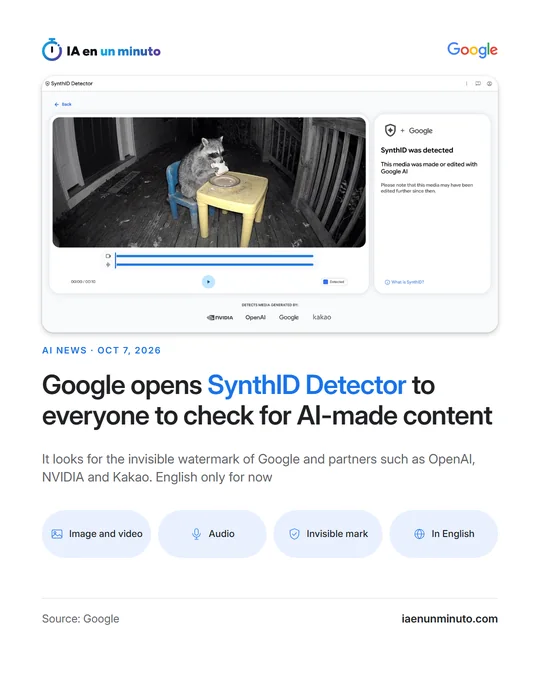
Anyone can now go to synthid.com to find out whether an audio clip, a video or an image carries SynthID, the invisible mark Google uses to label what its models create. The detector also recognizes output from partner models such as OpenAI, NVIDIA and Kakao, with Apple joining soon. The earlier version was aimed at media professionals; the new one is open in every country, for now in English only.
Google is opening SynthID Detector to everyone, its tool to check whether an image, a video or an audio file was made with AI.
Starting today, anyone can check whether a file was created with AI from Google or its partners, including OpenAI, NVIDIA and Kakao, and soon Apple. The tool looks for SynthID, the invisible watermark Google has been adding since 2023 to the content its models generate. It is available worldwide, in English only for now, at synthid.com.
Until now there was an early version, introduced last year, designed to help media professionals verify content. Google says it has already watermarked more than 180 billion images and videos and the equivalent of 240,000 years of audio, and that its verification features in Search, the Gemini app and Chrome now handle more than 1 million requests a day.
It only detects content made with AI from Google or those partners.
Why it matters · analysis and opinion
Checking where a doubtful image came from is no longer a job for newsrooms alone and is now within anyone's reach, from a company that receives a suspicious photo to someone unsure about a video going around social media. The limit lies in the tool itself: it only finds the mark that Google and its partners add, so a negative result does not prove a file is authentic, because it may come from a generator that does not use SynthID. Its usefulness will grow as more companies join the system, and the arrival of Apple points that way. In the meantime, the sensible course is to treat it as one more clue rather than a verdict, and to keep checking who published the file and where it first appeared.
Official source: Google · Written with the help of AI: how we make the news