Google previews policies that check every AI agent action before it runs
IA en un minuto newsroom · Editor: Jon Elgezabal
In 30 seconds
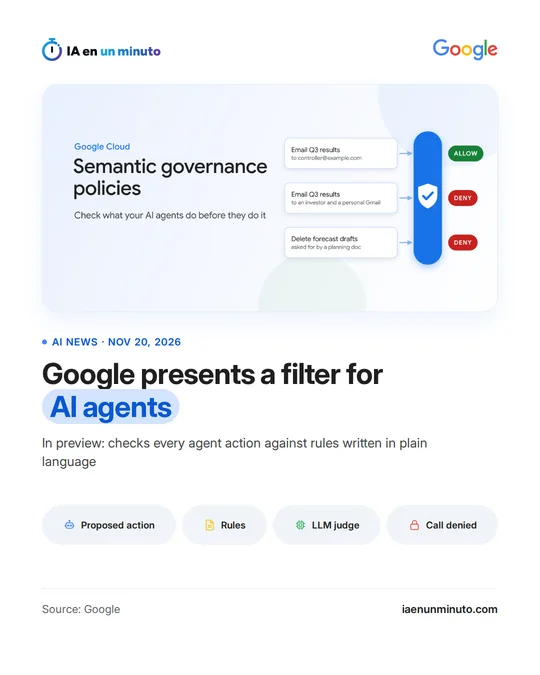
Semantic governance policies is a new Google layer, in preview in Gemini platform, that stops an agent's tool calls before they run. Every action is weighed against the company's written rules and against the user's request, to catch hijacking. When a call fails, the agent gets a denial notice and the decision is logged.
An AI agent allowed to read files and send emails can end up sending something it should not. To stop that, Google has introduced Semantic governance policies in preview in Gemini platform: rules that examine every tool call an agent proposes before it gets to run. The company explained it on Friday, November 20, on its developer blog.
The system runs two checks. The first looks at whether the call follows the rules the company drafts in natural language. The second, switched on by default, looks at whether the action has strayed from what the user requested, as protection against agent hijacking: for example, when a document hands it an instruction no one gave. Google points out that permissions only say what an agent may do, not whether a specific call respects the rules.
The decision is made by an AI model acting as judge. If the call fails, the judge swaps it for a denial message that can be configured, and the verdict and its reasoning are recorded in Cloud Logging. Responses that only contain text are not evaluated, and neither are streamed responses. It works with agents that reach their model through the Gemini API, the Anthropic API or OpenAI-compatible APIs.
Google itself warns that, because they come from a model, the verdicts can vary, and it recommends trying the policies first in a dry-run mode and using them alongside other controls.
Why it matters · analysis and opinion
The risk with agents is no longer just what they say but what they do: send a file, delete something or call a tool. Until now the usual defense was permissions, which cannot tell a legitimate action from the same action sent to the wrong recipient. This layer reviews each step for its meaning, and that brings agents closer to tasks involving sensitive data. It has limits: the judge is another model and can get things wrong, so it does not replace human review where it matters most. Anyone building agents at work can start now by writing their rules in clear sentences and describing every tool well.
Official source: Google · Written with the help of AI: how we make the news
What does it mean for your business? · analysis and opinion
This affects small businesses and freelancers in Spain and Latin America that already connect AI agents to their email, shared folders, or documents. Google's tool is in preview and is designed for those who build their own agents on Gemini platform and route their traffic through Agent Gateway, so most small businesses will not configure it today. Those who only use an assistant to draft text or answer questions do not need it either: responses that contain only text are not evaluated, because they take no action.
The useful lesson for everyone is the underlying one: an agent having permission to send emails does not mean every email it sends follows the company's rules, and a document with hidden text can give it orders that nobody gave it. Our advice is to give the agent only the tools it strictly needs, ask for human confirmation before deleting files or writing to external addresses, and put in writing, in simple sentences, what information cannot leave the company and to whom.
If this feature is tested, there are two things worth keeping in mind. Being a preview, how it works may change before the final version. And the judge uses tokens on each review, which are logged in Cloud Logging along with each decision, so it is wise to keep an eye on that cost and set a custom denial message, because the judge's rationale can quote the internal rules.