Google builds an isolated, realistic copy of the internet to train and evaluate its AI agents without real-world risk
IA en un minuto newsroom · Editor: Jon Elgezabal
In 30 seconds
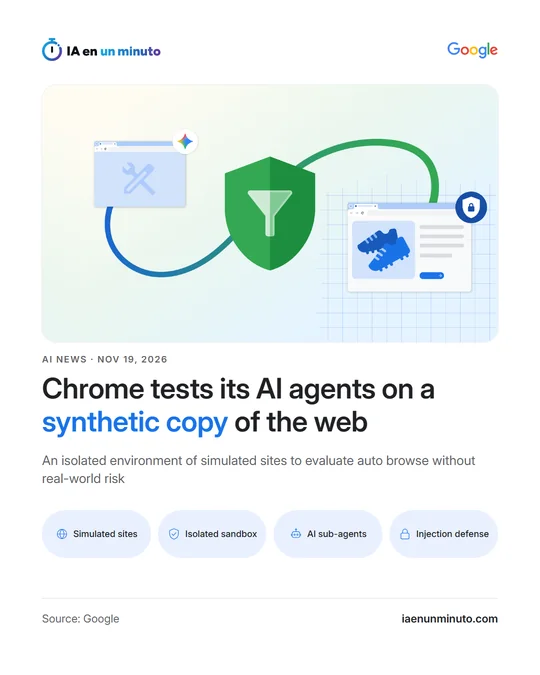
Chrome no longer rehearses its AI agents on the internet, but on a fake double of the web set up by Google itself. There, auto browse visits sites that look authentic even though other agents built them, and it never touches real pages. Google uses it to repeat every trial under identical conditions and throw attacks at it with no danger to anyone.
Google has unveiled the "mirror dimension", a synthetic copy of the web that Chrome relies on to put its AI agents through their paces without exposing them to the real internet. The company described it on Thursday, November 19, on its blog: an isolated environment holding thousands of simulated sites, modeled on common user journeys, where it assesses auto browse, the Chrome feature that browses the web for the user.
According to Google, training and evaluating these agents means running thousands of actions across hundreds of sites, and doing so on the public web does not work, since it never stops changing, nor is it responsible, since an agent with free access can do damage. Each test also has to begin from the same point, with nothing left over from the previous one.
The agent runs a Chrome with no interface inside an isolated container (gVisor). When it tries to open a real address, such as youtube.com, the connection never reaches the internet: a local proxy picks it up, serves the simulated version of that site and creates, on the spot, security certificates that this Chrome accepts. That keeps the agent from noticing it is in a test, because, as Google explains, a model that suspects it is being evaluated may behave differently.
The sites are not made by hand. A person defines the journeys to be tested and a team of AI agents splits up the work: one researches and writes the specifications, another codes the site and several critics review it, using Chrome DevTools for agents, until it behaves like a real one.
The environment is also used to attack the agents with indirect prompt injections, orders hidden in the content of a page. Google says its automated system produces more than 1,000 candidate tests a day for each security engineer, over 30 times what one person would do by hand, and believes the same architecture could be used to evaluate coding agents.
Why it matters · analysis and opinion
The problem Google is solving is less obvious than it seems. An agent that browses on its own can buy, delete or send something by mistake, and rehearsing that on the real web risks harm to third parties. But the most revealing detail is another one: models can already notice they are in an exam and change their behavior, which forces the test to be hidden as carefully as it is designed. For companies starting to let an agent use their browser or their applications, the lesson is practical: before giving it access to real systems, they need a test environment that closely imitates the real one and attack tests with malicious content. What is still unknown is how much of what an agent passes here holds up outside.
Official source: Google · Written with the help of AI: how we make the news