Citi will hold customers responsible for what third-party AI agents do with their accounts
IA en un minuto newsroom · Editor: Jon Elgezabal
In 30 seconds
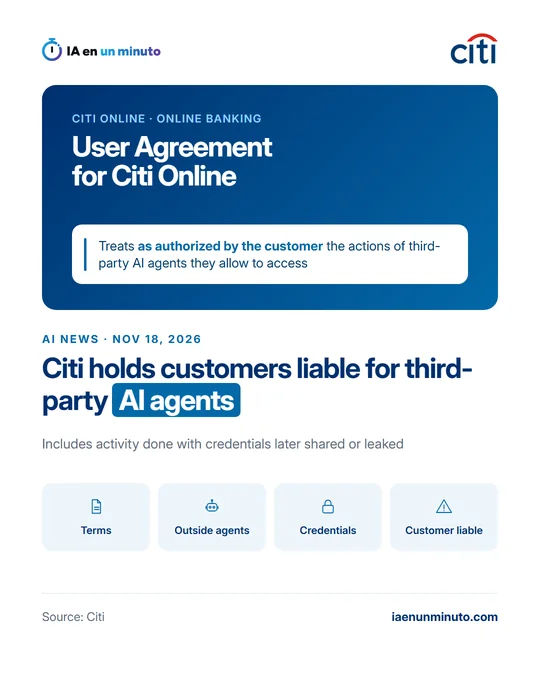
Citi has added a Section H on outside AI agents to the terms of its online banking. Under it, anything those agents do, or anyone using leaked credentials, counts as authorized by the account holder, who must also supervise them. Bank of America, JPMorgan Chase, PNC and Citizens have moved the same way, according to TechCrunch.
Citi changed the terms of Citi Online, its online banking service, this week to spell out who answers when a third-party AI agent acts on a customer's account: the customer. The User Agreement, updated in November, adds a new Section H on these agents, whose use it discourages on both the website and the Citi Mobile app.
Under the new wording, a customer who hands their login details to an outside agent, or lets it into their accounts, will have everything that agent does treated by Citi as authorized by them. The same applies if those details end up shared with or leaked to other people or other agents. The bank takes on no duty to check such actions even when they clash with the instructions the customer gave the agent, and the customer bears the cost of misread instructions, unrequested actions or moves beyond the permission granted, unless applicable law allows otherwise. Keeping an eye on the agent is the customer's job, and Citi may cut off any agent's access whenever it chooses, with no warning. The section does not cover agents and tools that Citi itself provides.
The terms also say that by giving an agent access, the customer allows Citi to pass it their data, sensitive personal information included, and that the bank's privacy notice does not extend to that agent.
A Citi spokesperson told TechCrunch that the bank wants customers to grasp the risks of sharing their credentials with these tools, and that those who give third-party agents account access are "responsible for activities conducted through those agents." The outlet reports that Bank of America and JPMorgan Chase announced similar policies in October, that PNC changed its terms on Wednesday, November 18, and that Citizens wrote to its customers this week with the same warning, according to an email TechCrunch saw. By way of contrast, it notes that the personal finance tool Anthropic launched this month is read-only and cannot move money.
Why it matters · analysis and opinion
The change clashes with one of the promises of AI agents: handing them tasks involving real money, such as paying bills or moving savings. Under these terms, the bank does not take responsibility for their mistakes or for what happens if someone steals the credentials they were given, and the customer carries all of it. That several of the largest banks in the United States are moving at once points to an industry stance, mixing caution about attacks with defense of their direct relationship with the customer. Real-world use still needs an access route agreed with the banks, with limited permissions and shared responsibilities. Until that exists, the sensible course is not to give any outside agent the credentials to a bank account and to prefer tools that only read.
Official source: Citi · Written with the help of AI: how we make the news
What does it mean for your business? · analysis and opinion
This news directly affects those who use Citi Online or Citi Mobile, and concerns banks in the United States: Citi, JPMorgan Chase, Bank of America, PNC and Citizens. A freelancer or small business in Spain or Latin America working with a different bank will not see its terms change today because of this. Even so, it sets a criterion other banks could follow when a third-party AI agent operates with an account: whatever it does is attributed to the account holder, even if it misreads an instruction or goes beyond what was asked. In our judgment, the prudent course is never to hand over the username, password or security codes for a bank to an external assistant or agent, not even for tasks that seem harmless, such as checking transactions or paying bills. If a tool only needs to review the history, it should have read-only access and no ability to operate. Before connecting any application to a business account, it is worth reading the bank's terms and asking the institution whether that path is allowed; and if credentials have already been shared with a service, changing them as soon as possible. The risk is not small: under Citi's terms, an operation initiated by an agent is considered authorized by the customer, and the data the bank provides to the agent falls outside its privacy notice.