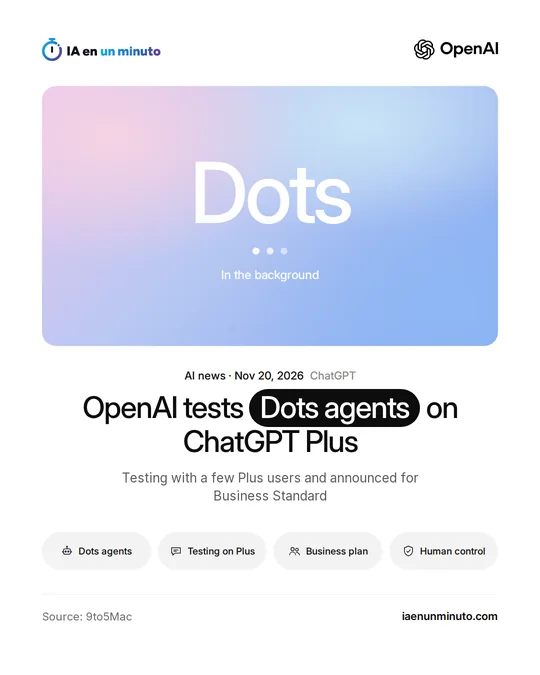
OpenAI tests its Dots agents with some ChatGPT Plus users and starts rolling them out on Business Standard
IA en un minuto newsroom · Editor: Jon Elgezabal
In 30 seconds
OpenAI is trying out its Dots agents among some ChatGPT Plus customers and will extend them to the Business Standard plan, according to Thibault Sottiaux on X. Until now they were reserved for people paying for Pro, Business Premium or Enterprise. The company has set no date for the rest of Plus and has not clarified which usage limits will apply.
OpenAI has begun opening its Dots agents to more ChatGPT users. Thibault Sottiaux, head of engineering for Codex and ChatGPT, said on X on Thursday, November 19, that the company is trying them out with a limited group of ChatGPT Plus subscribers and is also starting to bring them to the ChatGPT Business Standard plan, as reported by 9to5Mac. Until now they had only been offered on the Pro, Business Premium and Enterprise plans.
OpenAI has not said when they will reach the rest of Plus subscribers or whether they will get the same usage limits there as on the higher plans. On Pro and Business Premium, chats with Dots do not eat into the regular ChatGPT limits, although the more complex tasks have their own allowances.
The company unveiled Dots in late September at its annual developer conference. They are agents that handle complex workflows in the background; they run on GPT-6 Astra, joined this month by GPT-6.1 Terra, and can connect to more than 4,000 apps. According to Geeknetic, each agent works inside its own virtual machine, isolated and hosted on remote servers; companies can mark through IT which tasks require a manual permission, and delicate actions, such as changing a password, always stay in a person's hands.
In replies to the announcement, one user complained that their Dot asks for authorization for almost any action, even after being granted permanent permissions.
Why it matters · analysis and opinion
Until now, Dots belonged to the expensive plans; bringing them to Plus and Business Standard is the step that puts them within reach of freelancers and small teams. But the announcement leaves out what decides whether they are useful day to day: how many tasks each plan will allow and when they will reach every subscriber. The user's complaint points to another balance still to be struck. An agent that asks permission for everything saves little time, and one that never asks is unsettling when it can get into thousands of apps. Anyone who already has access would do well to try it on a low-stakes job, check which apps it is connected to and adjust the authorizations before trusting it with anything important.
Source: 9to5Mac · Written with the help of AI: how we make the news
What does it mean for your business? · analysis and opinion
The ones most affected are small businesses that already pay for ChatGPT Business Standard, because OpenAI has started bringing Dots to that plan. Freelancers with a Plus account will only see Dots if they are among the small number of subscribers chosen for the tests, and OpenAI has not said when they will reach the rest or what limits they will have on that plan. Anyone who does not use paid ChatGPT does not need to do anything for now. Before letting an agent work on its own, it is wise to decide which tasks need manual authorization, something OpenAI lets IT teams configure. Our advice is to start with a low-risk workflow, for example an internal report, and review the first results even though the whole point of the product is not having to do that. It is also worth opening up only the applications it really needs: each Dot can connect to more than 4,000 applications, so if it is going to touch customer data it is worth limiting what it can see beforehand. The clearest risk is granting too many permissions to a tool that has just arrived. There is also the opposite problem: at least one user has complained that the agent keeps stopping to ask for permission, so it makes sense to expect an adjustment period before counting on any time savings.