OpenAI says Codex found the root cause of more than 600 ChatGPT performance problems
IA en un minuto newsroom · Editor: Jon Elgezabal
In 30 seconds
OpenAI has detailed Performance Factory, the system in which Codex agents track down and correct speed and availability problems in ChatGPT. Codex looks for where each alert comes from, another agent puts that diagnosis to the test, and an engineer approves or rejects the proposed change. OpenAI acknowledges that landing the solution is proving harder for it than spotting the cause.
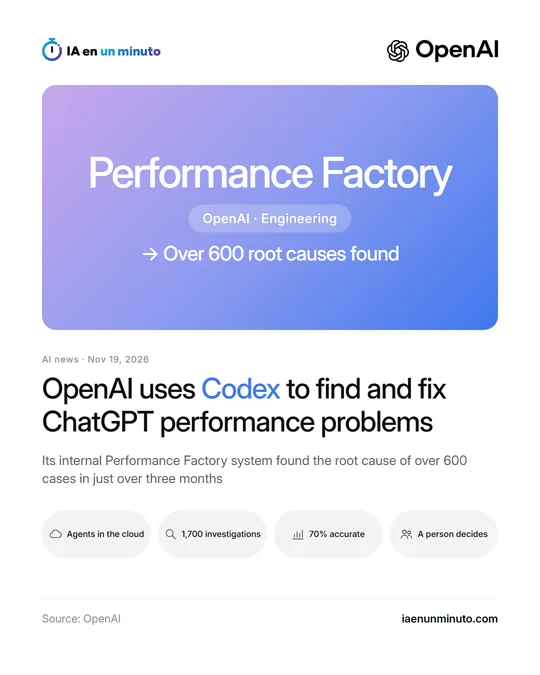
OpenAI today, Thursday, November 19, explained how Performance Factory works: an internal system that puts Codex agents, its AI coding tool, to work in the cloud to investigate and correct ChatGPT performance problems, such as rising latency or drops in availability. Two of the company's engineers lay it out on its blog.
Before Codex, according to the company, its engineers went through metrics, logs and traces by hand and read code to work out why something had become slower; over time they had built up more than 30 in-house performance tools. The next step was to investigate alongside Codex, then to capture their method in a shared skill called perf-forensics, and finally to launch the investigation automatically every time an alert goes off.
In the workflow built for regressions, each alert opens a task. One agent works out when the degradation began, which requests it hits and which deployment or configuration change explains it. A second Codex session then tries to take that diagnosis apart and, if it holds up, Codex prepares the fix as a proposed change on GitHub. An engineer reviews it and decides whether it goes in. After deployment, another agent checks whether performance is back to its earlier level; if not, the task returns to the investigation stage.
In just over three months, that workflow tracked more than 1,700 investigations and located the root cause in more than 600, which the company sums up as 17 automated investigations a day. Reviewing 100 diagnoses by hand, OpenAI rated 70% as accurate; the remaining 30% needed more work or did not manage to prove the cause.
The company admits that getting the correction right has been harder than finding the origin: some of the agents' proposals were more complicated than needed or created new problems, so it also added a critical review of every fix. OpenAI says it is exploring letting agents eventually ship low-risk changes with no human involved. Performance Factory is an internal company tool and is not offered as a product.
Why it matters · analysis and opinion
What stands out is not that an AI company uses its own tool, but where it puts it: in on-call work, investigating alerts, which usually depends on a few people who know the system inside out. The division of roles also says a lot. One agent proposes, another tries to knock the proposal down and a person signs off, a structure any team can imitate without waiting for a product to exist. Admitting that fixing is harder than diagnosing lowers expectations: what works best today is finding the origin, not changing code without supervision. For anyone who maintains their own software, the practical lesson is to start there, with repeated, well-documented investigations, before letting an agent touch production.
Official source: OpenAI · Written with the help of AI: how we make the news