Perplexity unveils Multiagent, up to 16 AI agents that check each other's work
IA en un minuto newsroom · Editor: Jon Elgezabal
In 30 seconds
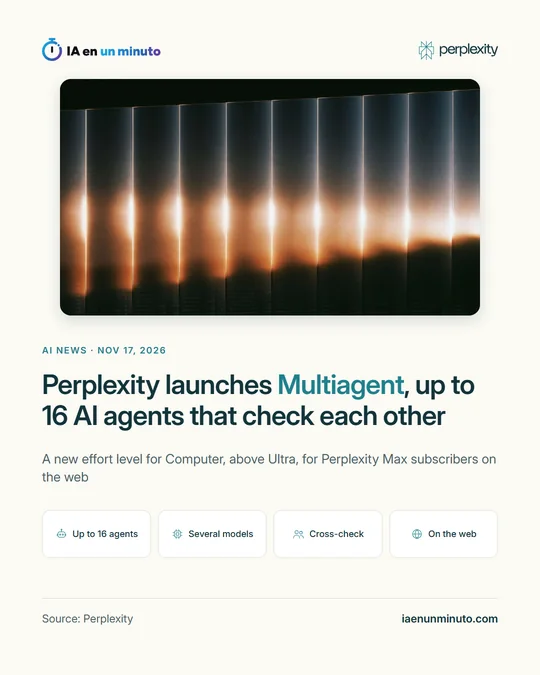
Perplexity is rolling out the Multiagent level in Computer, where a lead agent coordinates up to 16 agents running on different models. Each one shares what it discovers with the rest and goes over their work to find contradictions before delivering one answer. Perplexity Max subscribers can already use it from the web by choosing it in the effort control.
On Tuesday, November 17, Perplexity introduced Multiagent, a new effort level for Computer, the company's agent platform for digging into hard questions and handling jobs that take several steps. It sits above Ultra and is meant for the tool's most demanding assignments, according to the company's announcement. In September, Perplexity had already given Computer four effort settings, in which a lead agent plans the task and hands parts of it to supporting agents.
With Multiagent, that lead agent can assign up to 16 agents and keeps part of the work for itself. The agents run on different models, work at the same time, pass what they find straight to one another and review what the others do to spot assumptions that clash, before pulling everything into a single result. That is the difference from Ultra, where supporting agents report only to the lead.
Planning is handled by Claude Fable 5.2, and the default team mixes Gemini 4 Carbon, GPT 6.1 Sol and Claude Opus 5.5; other models can be requested in the query. Perplexity gives as examples financial forecasts with several scenarios, reviewing annual reports and analysing the documents of a deal (due diligence). Users can see which agents and models are active, and stopping the thread stops the entire team.
Every Perplexity Max subscriber can now use Multiagent through the web version: it is picked in Computer's effort control when starting a new task. The announcement gives no pricing or usage limits specific to this level.
Why it matters · analysis and opinion
The announcement confirms an idea that is taking hold among AI assistants: no model is the best at everything, so the value lies in combining them and having them watch over one another. Perplexity is not competing here with its own model, but as the conductor of those from Anthropic, OpenAI and Google. The examples it picks, finance, annual reports and acquisition deals, are jobs where a mistake is expensive and where an automatic second opinion makes sense. To use it with judgment, it remains to be seen how much a task of this kind consumes and whether the results beat those of a single well-guided model. Until there is data, it is worth trying it on a case that has already been solved and comparing.
Official source: Perplexity · Written with the help of AI: how we make the news