USA Today sues OpenAI for training its models on its articles without permission
IA en un minuto newsroom · Editor: Jon Elgezabal
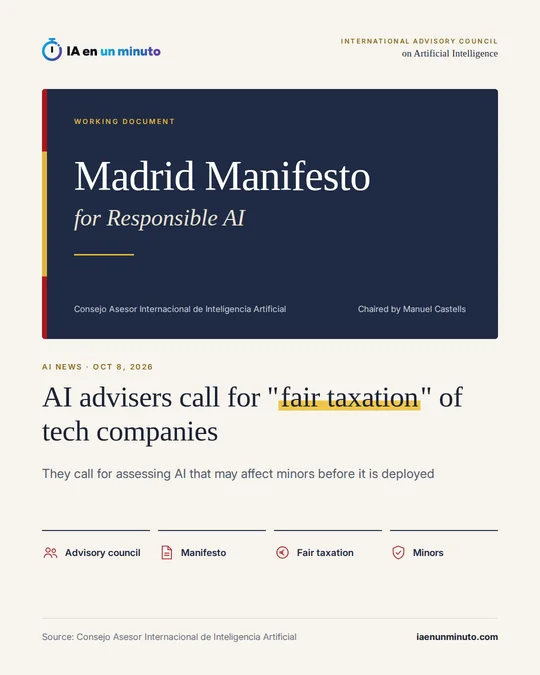
In 30 seconds
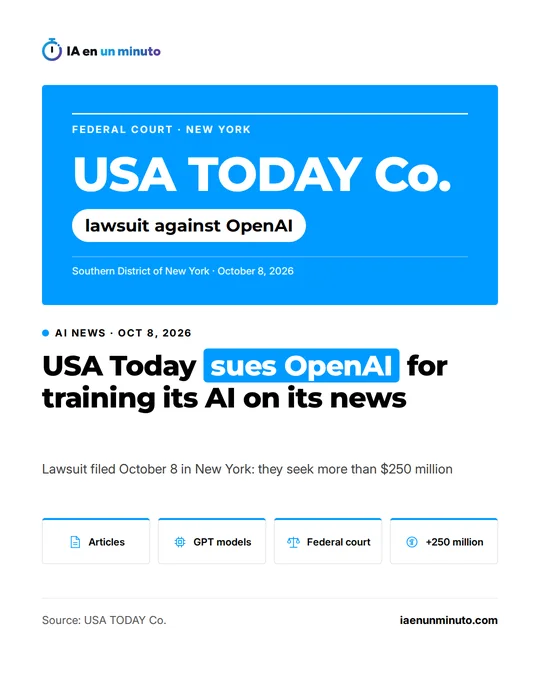
The group behind USA Today has taken OpenAI to a federal court in New York for using its journalism without permission. The complaint argues that ChatGPT summarizes and rewrites pieces from its 19 newspapers, which pulls readers away from their websites and subscriptions. They want damages above $250 million and want the GPT models built on that material destroyed.
USA Today has sued OpenAI for using its articles to train its models.
USA TODAY Co. and 13 companies in its group, which together hold the copyrights to 19 newspapers such as USA Today, the Detroit Free Press and The Arizona Republic, filed the lawsuit on October 8 in federal court in the Southern District of New York. They allege that OpenAI's models copied hundreds of thousands of their articles without permission and that ChatGPT reproduces and repackages that journalism in its answers, so users have no reason to visit the original website or pay for a subscription. They are seeking more than $250 million in damages and the destruction of the GPT models and training data that contain their content.
The complaint notes that the law allows up to $150,000 for each willful copyright infringement, plus up to $25,000 for each time the copyright management information was stripped from a piece of content. It also argues that OpenAI knew its models memorize the texts they are trained on and that its output filters did not stop responses from reproducing content from anyone who had not sued it.
It includes examples in which GPT-5.6, one of OpenAI's models, finds articles from the Indianapolis Star and the Detroit Free Press and returns extensive summaries that follow the structure of the original; in the Detroit Free Press case, largely. The plaintiffs are asking for a jury trial.
With this, they join a long list of copyright holders who have sued OpenAI and other AI companies, many of whose cases have already been consolidated in that same court.
Why it matters · analysis and opinion
The lawsuit is not limited to training: it also targets what ChatGPT delivers when someone asks it to find and summarize a news story. If a court comes to see those summaries as a substitute for the original, the question would no longer be only how the model was built but also how it is used. For newspapers it is as much a business argument as a legal one, because it is about lost visits and subscriptions. Anyone who builds search-enabled assistants into their own products has a practical signal here: citing and linking a source is not the same as rewriting an entire article so that nobody needs to open it. It remains to be seen whether this case will end up being handled together with those already consolidated in New York and how long it will take to resolve.
Source: USA TODAY Co. complaint against OpenAI (PDF) · Written with the help of AI: how we make the news