Spain approves decree to create a network of up to 20 research centers in AI, chips and quantum
IA en un minuto newsroom · Editor: Jon Elgezabal
In 30 seconds
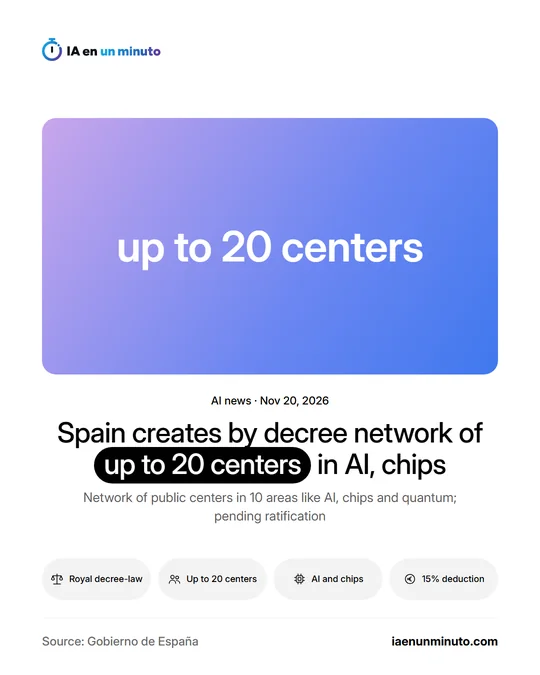
Spain's Council of Ministers gave the green light on Friday to a royal decree-law to boost Spanish research in AI, chips and quantum. The package groups up to 20 public centers into a network with more freedom to hire and purchase; the Barcelona Supercomputing Center will become a public foundation and the tax deduction rises to 15%. The decree still needs approval from the Standing Committee, since the Cortes are dissolved.
Spain's Council of Ministers approved on Friday, November 20, a royal decree-law with urgent measures to make Spanish science more competitive and technologically sovereign, above all in artificial intelligence, chips and quantum computing. Prime Minister Pedro Sánchez introduced it with one line: "Sovereignty means not depending on multinationals or foreign interests", as reported by Xataka.
At its core is a network of no more than 20 public centers labeled of "national interest" in 10 strategic areas, such as AI, semiconductors, energy and quantum technologies. What is new is not the centers themselves but that special status: it gives them more room to hire staff, acquire equipment and take their research to market, and it will last five years, extendable to ten.
The decree also turns the Barcelona Supercomputing Center into a public foundation under the central government, able to set up a company to sell its results. It cuts red tape in R&D&I agreements and contracts, removes prior approvals for some contracts and allows higher pay for researchers funded from outside sources.
On the tax side, the most innovative companies will be able to deduct 15% instead of 12%; startups that are not yet profitable will be able to receive up to three million a year in deductions, up from one, and the bonuses for hiring R&D staff are extended from three to five years.
Spain starts from behind: in 2024 it spent 1.50% of its GDP on R&D, compared with about 2.2% on average in the EU. The package adds to the Deep Tech Spain Strategy, approved in May, through which the government expects to mobilize more than 8 billion euros by 2030, and to the 300 million approved in June for the European AI gigafactories, two of them in Spain (at the BSC and at CESGA).
The Cortes, Spain's parliament, are dissolved ahead of the general election on November 29, so ratification falls to the Standing Committee, which has thirty days to do it (as set by Article 86 of the Constitution). The next government could amend the text.
Xataka points out that the royal decree-law sets out specific measures but no money. According to the Cotec Foundation, for R&D to reach the target of 2.12% of GDP in 2027, investment would have to grow by close to 24% a year.
Why it matters · analysis and opinion
The measure mainly changes how public science is managed, not how much is invested in it. Giving certain centers more freedom to hire and buy tackles an old complaint from researchers, red tape, but without new funding its effect will depend on the money they already have. The timetable adds uncertainty: the text has to go through the Standing Committee, and the next government can rewrite it. For companies doing research in Spain, the sensible move is to wait for ratification before counting on the tax improvement in their accounts, and to watch which centers join the network, because they may become more agile partners for joint projects.
Source: Xataka · Written with the help of AI: how we make the news
What does it mean for your business? · analysis and opinion
What directly affects businesses is the tax side. According to the approved text, the deduction for the companies that innovate the most rises from 12% to 15%, startups that do not yet have profits will be able to claim up to three million a year in deductions, instead of one, and the bonuses for hiring R&D staff will last five years instead of three. It affects companies with activity in Spain that research or develop technology, including small tech companies and startups. For those that do not do R&D, or for companies in Latin America without activity in Spain, nothing changes directly.
Our advice is not to treat anything as final yet, because the rule is not yet confirmed and may change after the elections. The prudent approach is to review with your tax advisor which projects and which researcher hires could qualify for the new conditions, and to start documenting those expenses now: it costs nothing and works just as well under the current rules.
The risk is adjusting budgets or hiring decisions counting on the 15% before the decree is ratified. As for the network of centers, for now it is a science policy measure and the decree does not detail funding, so it is best seen as something to follow rather than an immediate opportunity for a small business.