Watch Duty uses a Gemini-powered tool to detect fire dispatches on firefighter radio in under 30 seconds
IA en un minuto newsroom · Editor: Jon Elgezabal
In 30 seconds
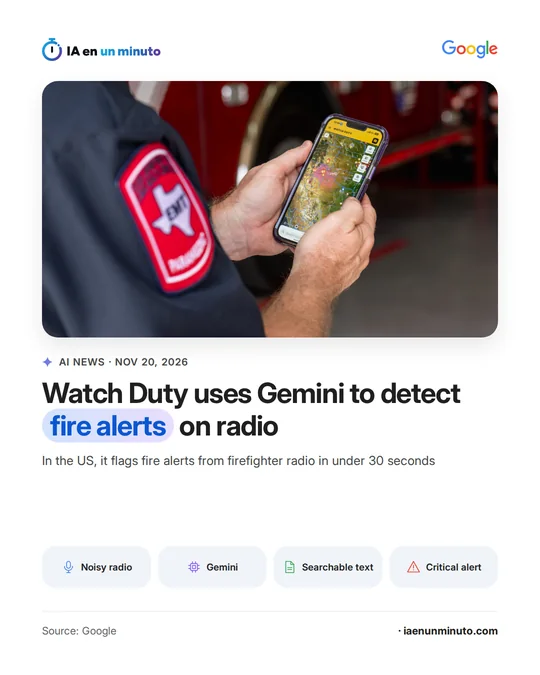
Google lent a group of its engineers and researchers to Watch Duty for six months to work inside the nonprofit wildfire alert app. Gemini now transcribes firefighter radio channels despite the static and converts their jargon into text. Google says errors drop from 38% to 22.34%, and a new dispatch takes under 30 seconds to surface.
Google said on Thursday, November 20, that a team of its engineers and researchers spent six months working full-time with Watch Duty, a nonprofit wildfire alert app in the United States whose staff are current and former firefighters, dispatchers and medics. The work was done at no cost to the organization, as part of the Google.org Fellowship program. Drawing on more than 20,000 hours of archived radio recordings, they built a tool based on Gemini, Google's AI, that strips out static and turns firefighting jargon into text people can search.
In much of the country, word of a new fire still arrives first over old analog VHF radio, mixed with engine noise, wind, static and fast tactical terms. Watch Duty's volunteers listen by hand to as many as 20 channels at once, according to Google's post.
According to Google, the word error rate fell from 38% to 22.34% when the radio audio comes in degraded. In areas with no other automated detection system, volunteers get a signal about a new dispatch in under 30 seconds. The tool transcribes over 200 hours of radio a day from about 400 active channels and was designed to handle more than 10,000 at once. Volunteer satisfaction with transcription tools rose from 35.3% to 92.3%.
In July, during the Railroad Fire, which broke out at night in Washington state, the tool picked up the first 911 dispatch on the radio in under 30 seconds. That gave the team time to confirm the fire and send the app's first-ever nighttime Critical Alert, the kind that gets through do-not-disturb mode.
The two had worked together before: in 2024 Google.org gave Watch Duty $2 million plus $300,000 in Google Cloud credits, and Google Cloud lifted its messaging limit from 600,000 to 1 million when the app's audience passed 16 million people last year.
Why it matters · analysis and opinion
What stands out here is not the model but the problem chosen: an old, noisy channel that still carries the most urgent information, and a team of volunteers who could not keep up with listening to all of it. The AI does not replace the person who verifies the fire; it takes away the heaviest part, deciphering the audio, and leaves the judgment to them. It also shows what it takes to get there: months of work alongside the users and a huge archive of real recordings. For any organization that receives alerts by voice, such as a call center, a maintenance service or an emergency room, the lesson is to start with its own data and measure the error before trusting the transcription. It remains to be seen whether the system will reach other emergency networks beyond this app.
Official source: Google · Written with the help of AI: how we make the news