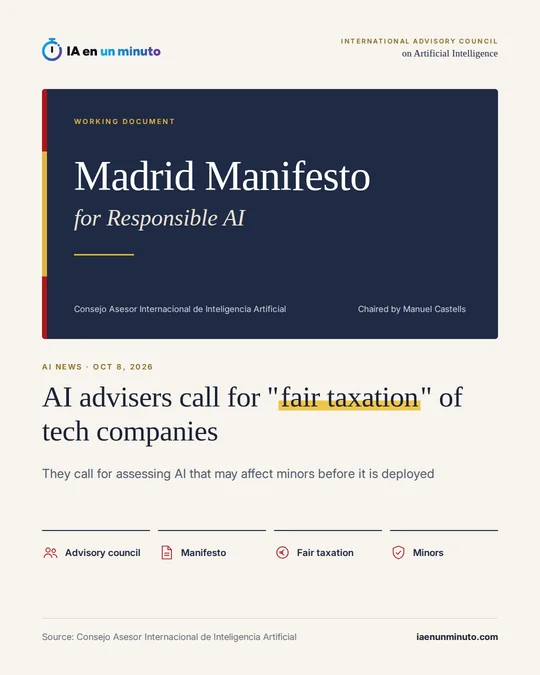
Spanish government's AI advisory council calls for "fair taxation" of tech companies and for assessing AI that may affect minors before it is deployed
IA en un minuto newsroom · Editor: Jon Elgezabal
In 30 seconds
The international council advising the Spanish government on AI, led by Manuel Castells, wants tech companies to face fair taxation. The manifesto also wants AI that could reach minors to pass an independent review before deployment. Minister Óscar López says the government aims to turn those ideas into laws if it wins re-election on November 29.
The group of experts that advises the Spanish government on artificial intelligence has put in writing what it wants done with it.
The International Advisory Council on Artificial Intelligence, an independent body chaired by Manuel Castells, today presented the Madrid Manifesto for Responsible AI, a working document for the government. It calls for "fair taxation" of tech companies and for AI systems that may affect minors to undergo independent assessments before they are deployed. It also asks that AI respect privacy and minimize the data handed over to those who develop it.
According to the press release from the Ministry for Digital Transformation and Public Service, the manifesto also calls for frontier models and agentic AI systems to undergo an independent assessment before deployment, with evaluators given access to the models, to documentation on their training data and to incident records, and for public authorities, not only operators, to be able to suspend or withdraw any system whose behavior escapes effective human control. It was presented by Castells and Francesca Bria, an expert in digital policy, alongside the minister, and it is signed by the members of the council, including Luciano Floridi, Carissa Véliz, Vint Cerf and Kate Crawford.
The Minister for Digital Transformation and Public Service, Óscar López, said that the government intends, if it is re-elected after the November 29 election, to "turn the ideas put forward into laws". At the same event he referred to other rules the government will keep pushing, such as the data center decree, which places new requirements on their environmental footprint, and the Minors Law, which includes a ban on social media for under-16s.
For now it is a working document, not a law.
Why it matters · analysis and opinion
Nothing the manifesto asks for binds any company yet. It is the proposal of an advisory body, and whether it becomes law depends on the government staying in office after the election and on its ideas then making it through parliament. Even so, it signals the direction the ministry wants to take: fair taxation of tech companies, independent checks before launching systems that may reach minors, and less personal data in the hands of those who develop AI. Companies that build or integrate artificial intelligence for young audiences have reason to start documenting now how they assess their systems and what data they collect, because that is the first thing they would have to show if these ideas become rules. What remains to be seen is how much of this text will survive the election calendar.
Source: El País · Written with the help of AI: how we make the news