IA en un minutoNewsBusiness and products
Anthropic adds Chinese to Claude but keeps access from mainland China blocked
IA en un minuto newsroom · Editor: Jon Elgezabal
In 30 seconds
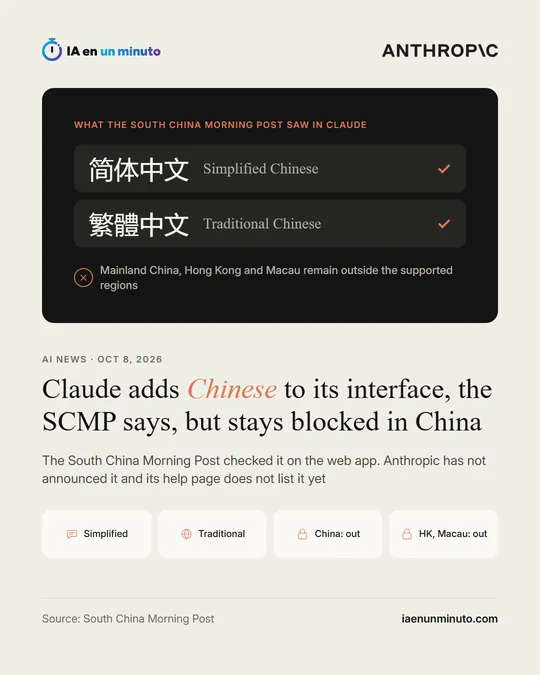
Claude now lets users switch its web interface to simplified or traditional Chinese in supported markets, as the newspaper South China Morning Post confirmed in its own checks. Anthropic has not answered the newspaper, and its help page still leaves the option out. Hong Kong, Macau and mainland China still have no official access, and analysts see the change as aimed at Chinese speakers outside the country.
The South China Morning Post found on Thursday, October 8, that the web version of Claude, Anthropic's AI assistant, now lets users choose simplified and traditional Chinese as the interface language in the markets where the service is available. Anthropic did not immediately respond to the newspaper's request for comment, and Claude's official help page does not yet list Chinese among its interface languages.
The change does not open the door to China. According to the same newspaper, mainland China, Hong Kong and Macau remain outside the official list of supported regions, and Anthropic continues to block users from mainland China. China briefly appeared as a billing country option before disappearing from the settings. Screenshots shared on X show UnionPay, China's dominant bank card network, as a payment option, but the newspaper was unable to confirm whether those payments are active.
Analysts quoted by the South China Morning Post said the target was most likely overseas Chinese communities rather than a move into the mainland Chinese market. Poe Zhao, a China technology analyst and the founder of Hello China Tech, said the changes aimed to serve Chinese-speaking users in supported markets such as Singapore, Malaysia, Taiwan and North America. "Offering a product in Chinese and serving users in China are two different decisions," he said, adding that the official supported-region list is the best indicator of Anthropic's strategy and has not changed. Su Lian Jye, chief analyst at Omdia, agreed that Anthropic appeared to be targeting the global Chinese diaspora.
Zhao does not expect the change to loosen the controls. As he told the newspaper, Anthropic relies on payment checks, IP detection and account reviews to tell overseas users apart from those based in China.
The newspaper notes that last week several Hong Kong users reported abrupt account suspensions after accessing Claude through a VPN (a connection that hides where users are connecting from). Anthropic has not publicly announced a new policy on VPNs. Last month, the company accused Chinese AI developers, including DeepSeek and Moonshot AI, of using fraudulent accounts and proxy services to harvest Claude's outputs at scale and train their own models on them.
Why it matters · analysis and opinion
Translating an interface looks like a small gesture, but here it separates two things that are often confused, language and country. Anthropic is reaching for Chinese speakers in markets where it already operates without moving the line on mainland China, and the signal that counts is still the list of supported regions, which has not changed. For companies with Chinese-speaking teams or customers in those markets, the change removes a practical barrier, because the tool no longer demands another language. For anyone trying to get in from unsupported areas, the message is the opposite, with payment, IP and account checks, and suspensions like the ones in Hong Kong. Before changing internal processes, the prudent move is to wait for Anthropic to confirm it and update its help page, because for now a newspaper has spotted it and the company has not announced it.
Source: South China Morning Post · Written with the help of AI: how we make the news