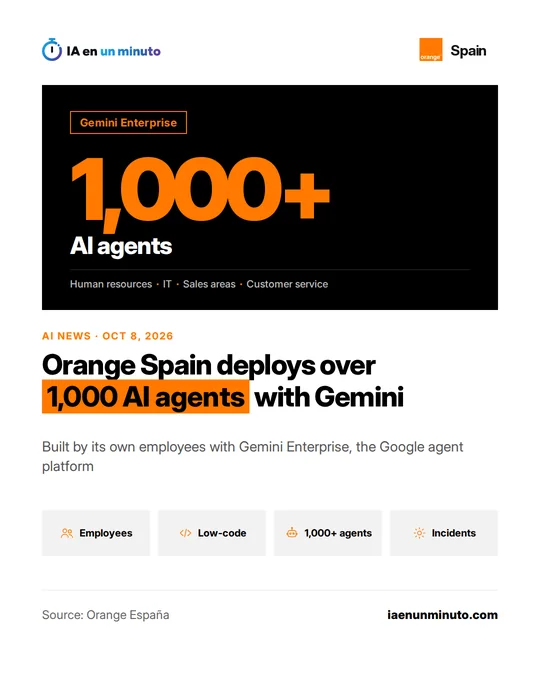
Orange Spain deploys more than 1,000 AI agents built by its employees with Gemini Enterprise
IA en un minuto newsroom · Editor: Jon Elgezabal
In 30 seconds
Orange Spain now has more than 1,000 agents, built by its own staff with Google's Gemini Enterprise. Its low-code environment lets people without a technical profile design them for human resources, IT, sales and customer service, always under central control. The agents sort incidents, trace network outages and answer questions about the company's internal knowledge.
Orange Spain has deployed more than 1,000 AI agents, and they were built by its own employees.
The operator has expanded its partnership with Google Cloud and uses Gemini Enterprise, the Google platform for building agents inside the company. Its low-code environment (for building with little or no programming) lets employees without advanced technical skills develop agents under centralized control. According to both companies, within 30 days the license activity rate was close to 100% across the operator's main business areas.
Until now, Orange Spain had been working with isolated pilots. With this step it is organizing the work as an enterprise-wide AI Factory and, according to the announcement, spreading agent creation across the organization helps prevent bottlenecks in the IT department.
The agents are spread across human resources, IT, sales areas and customer service. They classify technical incidents, look for the root cause of network or service outages, make corporate knowledge easier to access through natural language queries, and automate internal requests and routine tasks.
The rollout builds on the data foundation Orange Spain has been developing with Google Cloud since 2018, with its data warehouse on BigQuery and its data lake on Google Cloud Storage. So that answers are grounded in the operator's verified corporate data, the agents use retrieval-augmented generation (RAG) and semantic search.
Sources at both companies told La Razón that IT teams use a registry built into Gemini Enterprise (Agent Registry) to identify, approve and manage all agents, and that all traffic goes through an Agent Gateway that applies the company's security policies in real time. The announcement does not say how many licenses were assigned or what the deal is worth.
Why it matters · analysis and opinion
The leap Orange describes lies less in the technology than in who does the building. When the agents are created by the business areas themselves, the bottleneck is no longer the IT department but the governance of what gets created, which is why the agent registry and the gateway with security policies matter as much as the tool. The groundwork also counts, years spent organizing data before taking the step, and answers that rest on the company's verified information. A mid-sized company can copy the idea on a smaller scale, starting with repetitive, well-defined tasks such as sorting incidents or answering internal questions, and deciding in advance who approves each agent. The results remain to be seen, because the usage data comes from the companies themselves and there are no figures on savings or time.
Official source: Google Cloud · Written with the help of AI: how we make the news
What does it mean for your business? · analysis and opinion
What Orange has done is not just for big companies. The lesson applies to any small business thinking about building agents with tools that do not require programming: the most useful agents usually come from whoever knows the task, not from the IT person. Someone in administration knows better than anyone which internal requests come back every week, and someone in customer service knows which incidents could be sorted automatically.
What is not worth copying is doing things in the wrong order. Orange spent years organising its data before letting each department build agents, and even so it does it under central control. In a small company, in our view, the equivalent is simple: a shared list of which agents exist, who built them, which folders and programs they can reach and who answers for each one. Without that list, a few months later nobody will know which automation does what.
Our advice for getting started is to pick two or three repetitive internal tasks, such as answering questions about procedures or sorting requests, and have them built by the person who suffers them, with someone checking the permissions. Before expanding, measure whether they are really used: Orange boasts that in its main areas almost every licence was active within a month, and that is the figure that matters, not how many agents get built.