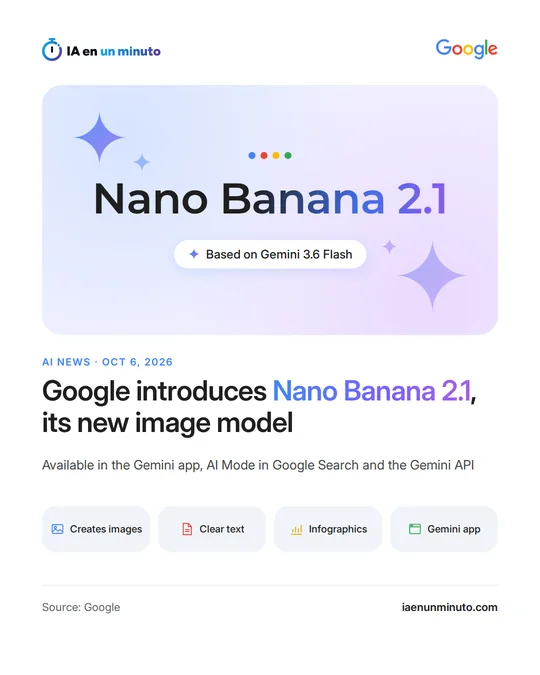
Google introduces Nano Banana 2.1, its new model for creating and editing images, based on Gemini 3.6 Flash
IA en un minuto newsroom · Editor: Jon Elgezabal
In 30 seconds
Nano Banana 2.1 is the new version of Google's image generator and editor, built on Gemini 3.6 Flash. In comparisons judged by people it comes out ahead of both Nano Banana Pro and Nano Banana 2, although the model card admits problems with small lettering and with characters. In the Gemini API, a 1K image costs roughly half as much as with Nano Banana 2.
Google has released Nano Banana 2.1, its new model for creating and editing images.
According to the model card, published on October 6, Nano Banana 2.1 is based on the company's Gemini 3.6 Flash model and understands text and images. It is an update to Nano Banana 2 (Gemini 3.1 Flash Image), and Google says it is designed to generate clear text for posters and intricate diagrams, and for infographics.
In its human evaluations, which compare images side by side, it outperforms Nano Banana 2 and Nano Banana Pro, its image model based on Gemini 3 Pro. In practice, according to The Decoder, Nano Banana Pro still often produces noticeably better images. Google also acknowledges some limitations. Small text often comes out blurry at 1K resolution, and character consistency between input images and the generated image is not always perfect.
It is available in the Gemini app, AI Mode in Google Search, Google AI Studio (its environment for developers), the Gemini API and Google Ads, among others. In the API, according to its pricing page, each 1K image (1024 x 1024 pixels) is equivalent to $0.0336, compared with $0.067 for Nano Banana 2. In its release notes, Google has deprecated the previous model in the API and recommends migrating to the new one.
Why it matters · analysis and opinion
For anyone already generating images with Google, the most noticeable change is the cost, because producing material in volume, from product sheets to posters or diagrams for a website, becomes considerably cheaper. With the previous model deprecated in the API, developers also need to plan the switch in their integrations. The lead over Nano Banana Pro should be taken with caution, since the tests are Google's own and The Decoder still sees better results from the Pro model. The model card also makes clear where not to rely on it yet, small lettering and characters that must look the same across several images. For a catalog or a campaign with the same mascot, checking every image is still essential.
Official source: Google · Written with the help of AI: how we make the news