OpenAI brings GPT-Live-1.1, the voice model that listens while it speaks, to its API
IA en un minuto newsroom · Editor: Jon Elgezabal
In 30 seconds
OpenAI is opening its GPT-Live-1.1 speech model, which debuted in ChatGPT in October, to people who build on its API. According to the company, it understands and transcribes speech better and keeps the same accent when it switches languages. WebRTC sessions on both versions also gain a standby mode that pauses computing during silences and charges less for each minute it lasts.
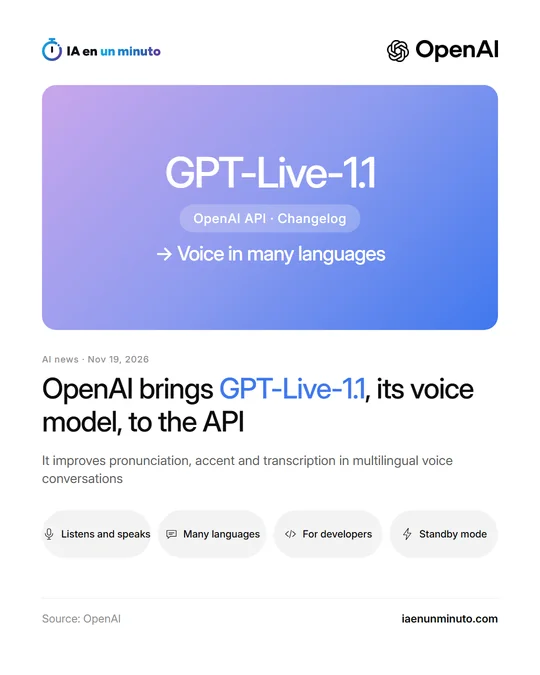
OpenAI has brought GPT-Live-1.1, the latest version of its voice model, to its API, the channel developers use to build its models into their own applications. The change appears in the API changelog dated Thursday, November 19.
According to the model page, GPT-Live-1.1 is a "full-duplex" voice model: it can listen at the same time as it talks. Compared with GPT-Live-1, it recognizes what is said to it more precisely and holds a steadier accent and voice from one language to another. The changelog spells this out as gains in pronunciation, accent consistency and transcription when a conversation mixes languages. Adopting it only takes setting gpt-live-1.1 in the configuration of an existing Live session, and developers can explain in everyday language at what point the model should pass a task to their own server (backend) for reasoning or tool use.
The update also adds a standby mode for WebRTC sessions, the real-time communication technology built into browsers, on both GPT-Live-1 and GPT-Live-1.1: while there is no activity, the model pauses processing, and picks it up again as soon as someone speaks.
Voice sessions are charged by duration: $0.05 per active minute and $0.02 per minute on standby, a reduced rate that applies only to WebRTC sessions while processing is paused. Use of the backend model and tools is billed separately, and GPT-Live-1.1 and GPT-Live-1 have separate limits on simultaneous sessions. The page leaves the model's performance and speed unspecified.
OpenAI had already introduced GPT-Live-1.1 for ChatGPT on October 15, in its release notes, with new voices in several languages.
Why it matters · analysis and opinion
Until this step, anyone building a voice agent on the OpenAI API worked with the previous generation while ChatGPT was already rolling out the new one. Now companies that handle calls or set up assistants in several languages can test the same voice ChatGPT users hear. The standby mode answers a practical problem: a real conversation is full of silences, and paying for them at the full rate made assistants that stay open for hours more expensive. What the page does not clarify is how well or how fast it performs, so it is worth measuring with in-house recordings, especially in Spanish and with regional accents, before replacing a service that already works.
Official source: OpenAI · Written with the help of AI: how we make the news