Thinking Machines Lab launches Inkling 2 Mini, an open AI model built to run on a laptop
IA en un minuto newsroom · Editor: Jon Elgezabal
In 30 seconds
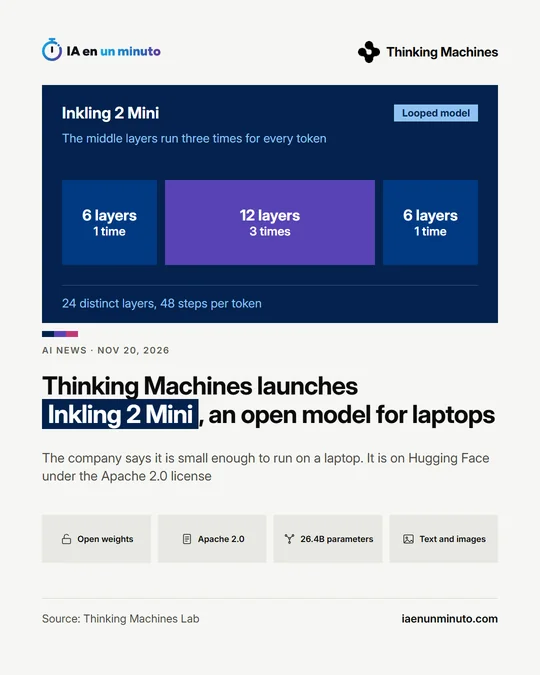
Inkling 2 Mini is the new open-weights model from Thinking Machines Lab, which pitches it as fit for a laptop and offers it on Hugging Face with an Apache 2.0 license. Thinking Machines Lab explains that it cycles its middle layers three times per token to reason better with less text. DeepSWE v1.1 and other tests put it ahead of open rivals its size, on unverified in-house numbers.
Thinking Machines Lab, the AI research company, has released Inkling 2 Mini, a model it says is small enough to run on a laptop. It is open-weights, meaning anyone can download it, and it is distributed through Hugging Face under the Apache 2.0 license.
Its most notable feature is that it works "in a loop": for every token, each piece of text it processes, it goes through its middle layers three times. The company argues this lets it reason more and reach the answer using fewer tokens, especially in tasks such as agent-driven coding. It is a mixture-of-experts model with 26.4 billion parameters in total, 3.4 billion of them active at each step, and it takes both text and images, with a one-million-token context, according to the Hugging Face blog.
To fit on a personal machine, nearly all of its weights use the low-precision NVFP4 format, and its total memory footprint is roughly 20 GB. The company's researchers say they ran it offline on a MacBook Pro during a flight.
Thinking Machines Lab claims it beats every open-weights model under 100 billion parameters on tests such as DeepSWE v1.1, a coding benchmark where it solves 48.2% of tasks, and Vals Index v2.2, at 46.5%. On other tests it acknowledges trailing Qwen3.8-27B. These are figures published by the company itself, which concedes that evaluation setups differ between models, and no third party has checked them.
Alongside the main model, it has released a research variant with a variable number of passes, meant for studying whether looped models are harder to oversee by reading their chain of reasoning. Its early analysis suggests that, at this size, looping does not meaningfully reduce that ability to oversee them.
Why it matters · analysis and opinion
The bet challenges the idea that only huge cloud-served models are good enough for agent-driven coding. If something that fits on a laptop performs like this, a company can work with code or documents without them leaving its own machines, which matters a great deal when confidential data is involved. Caution is warranted: the scores come from the company itself and each model was evaluated under different conditions, as it acknowledges. The Apache license allows commercial use, so anyone with a computer that has enough memory can try it now on real tasks before trusting the tables. The interest goes beyond performance: it is among the first looped models open to researchers, and it raises the question of how to watch reasoning that is never written down.
Official source: Thinking Machines Lab · Written with the help of AI: how we make the news