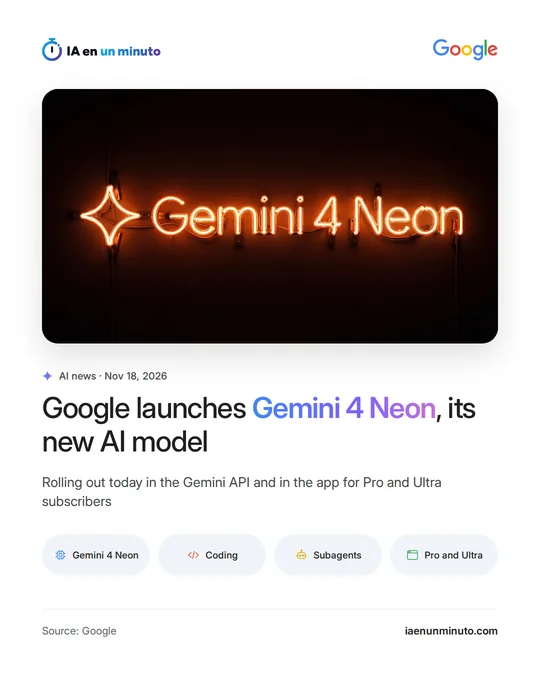
Google launches Gemini 4 Neon, a model for coding and complex tasks with a million-token context window
IA en un minuto newsroom · Editor: Jon Elgezabal
In 30 seconds
Gemini 4 Neon is Google's new pick for long code, analysis and science jobs, placed between Carbon and Hydrogen within the same family. Artificial Analysis puts it third on its general index and first on the one for agents that write code, according to figures Google itself publishes. Antigravity, AI Studio, Gemini for business and the app for Pro and Ultra subscribers have been getting it since Wednesday.
On Wednesday, November 18, Google presented Gemini 4 Neon, a new member of its Gemini 4 family built to see long coding, document and data work, and scientific research tasks through to the end. The company places it between Carbon, which it keeps for the hardest and longest projects, and Hydrogen, its fast model for day-to-day work.
In the API, Neon costs $3 for every million input tokens ($0.15 if that input is already cached, 95% less) and $15 per million output tokens. It accepts up to a million tokens of context, so a single request can bring together spreadsheets, PDFs, charts, audio and video.
Again according to Google, at its deepest reasoning setting, the highest of the four it offers, Neon scores 61 points and comes third on the Artificial Analysis Intelligence Index, an independent ranking, behind only larger and slower models. On that same firm's coding agent index it takes first place, with 58.6 points, and on the Vals Index it is second.
In Google Antigravity, the company's tool for coding with agents, Neon can work on its own or act as an orchestrator, splitting the job among several Hydrogen subagents running in parallel.
The rollout began that same Wednesday in the paid Gemini API, in Google AI Studio and Android Studio, in Gemini for business (through the API and the model picker) and, for paying Google AI Pro or Ultra users, in Antigravity and the Gemini app. Google is also announcing Gemini 4 Neon for cyber, a cybersecurity variant that will reach trusted defenders over the coming days through its Fairwind Program. The announcement does not say which countries it is available in.
Why it matters · analysis and opinion
What stands out is not that there is another model, but the slot Google puts it in: the middle one, for demanding tasks a company repeats many times a day. In that territory quality weighs as much as the cost of each job, and that is where the company puts the emphasis against Carbon. The rankings it cites come from third parties, but the results it highlights are its own choice, so the sensible move is to test it on real work before switching provider. The split between an orchestrator and several subagents in Antigravity points to how coding with agents will work: one model that decides and cheaper ones that carry out. Anyone already paying for the API can try it on a real case and compare the bill and the result.
Official source: Google · Written with the help of AI: how we make the news
What does it mean for your business? · analysis and opinion
This launch mainly affects two groups in Spain and Latin America: freelancers and small teams who already pay for Google AI Pro or Ultra and use the Gemini app or Antigravity, and companies that connect Gemini to their own programs through the API or use it with Gemini for business. Those who use the free version of the app will not have it for now, because Google reserves it for paid plans. Also, the rollout is gradual: it may not yet appear in every account.
Our advice is not to switch models blindly. The sensible approach is to pick two or three real everyday tasks, such as summarizing a long contract, cross-checking several spreadsheets, or fixing a bug in the code, and compare the result and the cost with the model currently in use. The rankings that Google cites are useful as a guide, but they do not replace a test with your own data.
In the API, it is worth keeping an eye on spending. Each million tokens generated costs $15, five times more than the input, so long responses raise the bill. Two things help keep it in check: cached input drops to $0.15 per million, useful when the same documents are queried again and again, and the four thinking levels let teams reserve the highest one for what truly needs it.