Anthropic says Claude solved two open problems in black hole physics
IA en un minuto newsroom · Editor: Jon Elgezabal
In 30 seconds
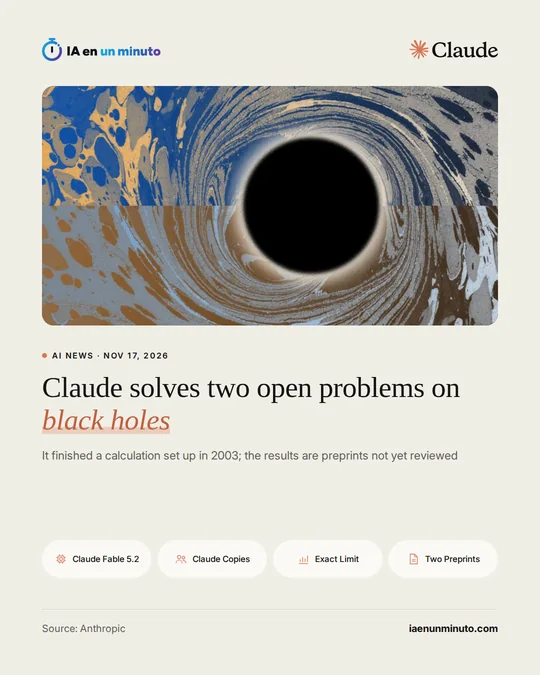
Anthropic says Claude Fable 5.2 has cracked two outstanding questions in theoretical physics about black holes. Claude finished, with a team of its own copies, a 2003 calculation nobody had completed, and the answer points to a sudden change. Anthropic is presenting both papers as preprints and notes that they have no practical uses and do not speak directly about the real universe.
Anthropic said on Tuesday, November 17, that its model Claude Fable 5.2 has solved two open problems in theoretical physics tied to black holes and to the search for a theory of quantum gravity. It has released both results as preprints, meaning papers that have not yet gone through peer review.
The first dates back to 2003, when a group of physicists laid out a calculation to find out whether a certain phase transition, the quantum counterpart of a hot gas turning into a black hole, is sudden or gradual. The work involved many thousands of terms and was never finished. Claude completed it by organizing a small team of agents, all of them copies of itself, which did almost every part twice on their own and compared it with results already published. The conclusion is that the transition is abrupt even in the regime where spacetime stops having a definite shape.
The second concerns the modular bootstrap, a technique used since 2009 to rule out inconsistent theories of quantum gravity in a simplified three-dimensional universe. According to Anthropic, Claude Fable 5.2 found a regularity in the numerical data that physicists had overlooked, borrowed a mathematical tool from another field and worked out the exact limit of the simplest version of that technique: a ceiling on the mass of the lightest black hole, set by a number of roughly 9.1266, together with proof that it cannot go any lower.
It all began in August as a side project by an Anthropic researcher, Hongbin Chen, who asked Claude for a list of open problems; it produced 22 candidates, and he put an agent on each of them for about six weeks. Weeks after one of those agents solved the first problem, a physicist who had tackled it separately with Claude, using a different method, reached the same answer. The second result was formally checked in September with Lean, a tool for verifying mathematical proofs.
Anthropic stresses that neither result describes the real universe directly or has practical uses, and that they do not settle the question of quantum gravity.
Why it matters · analysis and opinion
What stands out is less the physics than the method: a model that splits the work among several copies of itself, repeats each part separately and checks it against published work looks a lot like a small research group. Even so, the essential step is still missing before it can be taken as settled: peer review, and other physicists reproducing the results. It is also worth keeping in mind that the announcement comes from the company that sells the model, and that the project started as one researcher's test. For anyone who works with long, error-prone calculations, in science or engineering, the practical lesson is that these systems are starting to be useful for tedious tasks that can be checked, as long as there is a way to verify what they return.
Official source: Anthropic · Written with the help of AI: how we make the news