An Anthropic mathematician claims to have proven the Riemann Hypothesis with Claude, pending verification
IA en un minuto newsroom · Editor: Jon Elgezabal
In 30 seconds
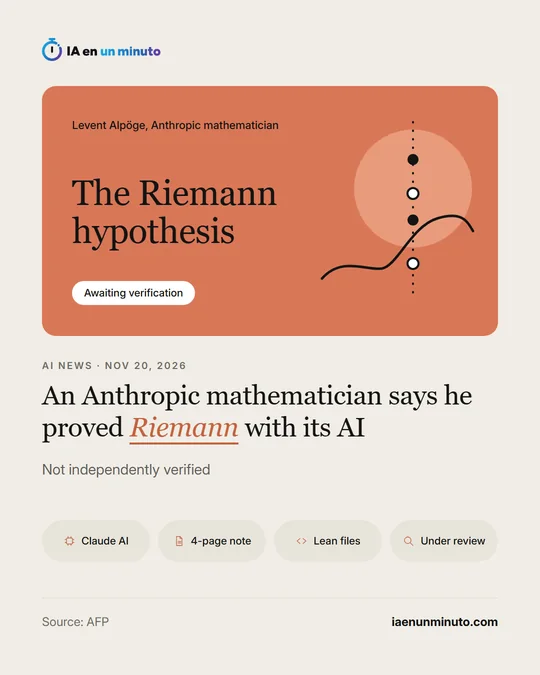
Levent Alpöge, who works as a mathematician at Anthropic, says Claude helped him crack a Millennium Prize Problem. No outside specialist has validated the work so far; he released it in Lean, split into 14 parts. AFP notes that the Clay Mathematics Institute wants publication in a reviewed journal and two years of scrutiny before handing over $1 million.
Levent Alpöge, a mathematician at Anthropic, maintains that he has found a proof of the Riemann Hypothesis with help from Claude, the company's AI model. He sets out the claim in a four-page note posted on his personal website on Friday, November 20, writing that he "believes" he discovered it while working with Claude, as reported by the AFP news agency. No one has checked the claim independently, and no outside expert has looked over the proof so far.
The German mathematician Bernhard Riemann posed the conjecture in 1859. It deals with how prime numbers are spread out and is regarded as the great open question of pure mathematics. It belongs to the seven Millennium Prize Problems chosen by the Clay Mathematics Institute in 2000, each carrying a $1 million reward; under the institute's rules, a solution has to appear in a peer-reviewed journal and hold up for two years.
Alpöge says the method also settles the generalized version of the hypothesis. For now he has only released the version of the proof written in Lean, a language that lets computers check mathematical reasoning, because, he explains, writing out the whole argument would take an enormous amount of space and he still lacks command of some of the mathematics involved; he says he intends to write it up properly. According to DiarioBitcoin, citing a report by Kingy.ai, the material comes in 14 parts with 175,187 Lean source files. An independent review confirmed it matches a mirror copy and that the statements can be written with Mathlib, Lean's mathematics library, but the check of the complete proof was still underway.
AFP adds that Alpöge consulted Anthropic CEO Dario Amodei before going public, and that Anthropic did not immediately answer its request for comment. In August, the company said a Claude version it had not yet released had strengthened an old result tied to the hypothesis, while stressing that this was not a proof. Two months ago, OpenAI said one of its models had solved another Millennium Prize Problem, on the equations that govern how fluids move; mathematicians quoted by AFP say that proof looks correct but has not been fully checked.
Why it matters · analysis and opinion
In August, Anthropic spoke of improving a result linked to the hypothesis; now one of its own mathematicians is claiming the whole proof, and doing so from inside the company that sells the model. That calls for separating two things: Lean being able to check a proof does not mean it has already checked this one, and full verification is still pending. The OpenAI fluids precedent shows that such validation is not quick. For anyone following this from a business, the lesson is about method: an announcement like this is worth only as much as its outside review, and it makes sense to wait for independent mathematicians and the checkers to finish before taking it as evidence of what these models can do.
Source: AFP (Yahoo Finance UK) · Written with the help of AI: how we make the news