A child safety institute gives ChatGPT's teen mode its worst safety rating
IA en un minuto newsroom · Editor: Jon Elgezabal
In 30 seconds
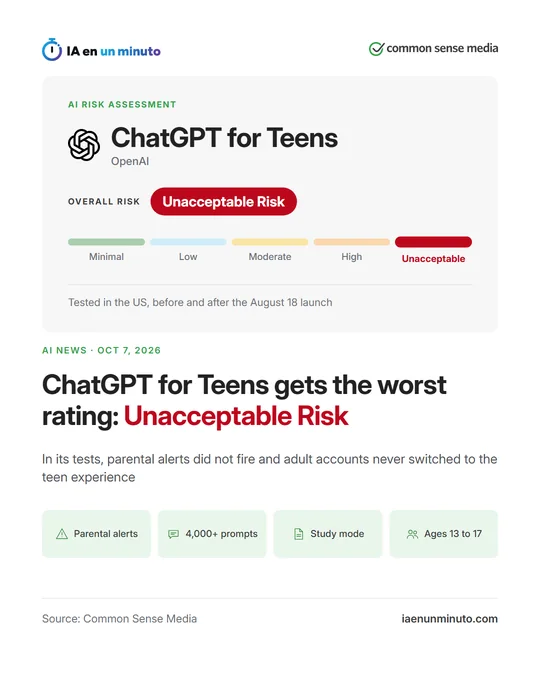
Common Sense Media has placed ChatGPT for Teens at the most severe level of its scale after putting more than 4,000 prompts to it from profiles aged 13 to 17. Alerts to parents come late on topics such as suicide, and ChatGPT gave no help in over a quarter of the crises that called for it. Common Sense Media wants OpenAI to pull its promotion, and OpenAI counters that this testing does not show how its safeguards really work.
Common Sense Media, a US nonprofit focused on children's safety, has given ChatGPT for Teens its worst rating: "Unacceptable Risk", the top level of its five-level scale.
ChatGPT for Teens is the set of settings and protections that OpenAI has been turning on since August 18 for accounts of users aged 13 to 17. The Youth AI Safety Institute, the Common Sense Media institute that evaluates AI safety for minors, ran more than 4,000 prompts from accounts registered with those ages, half before that launch and half after, and the answers were reviewed by child psychiatrists and a pediatrician. Testing was done in the United States.
This is what they found.
Parental alerts did not fire when testers talked about suicide, self-harm or eating disorders. According to the report, they only arrive after a lot of conversation about those topics, not because of how serious the message is.
After the launch, ChatGPT failed to offer a support resource in more than one in four crisis cases where one was needed.
A new "Show me the answer" option lets teens skip Study mode, the ChatGPT mode that guides them through homework step by step with hints instead of giving the answer.
Accounts registered as adults never switched to the teen experience, not even when the tester said they were 13 and the chatbot acknowledged it.
The organization is asking OpenAI to stop marketing the product and to keep minors off ChatGPT until it can offer them a safe experience. OpenAI has responded, according to The Next Web, that it does not believe this testing reflects how its teen safeguards work in practice.
Why it matters · analysis and opinion
The report dismantles a comfortable idea: that switching on teen mode is enough for parents to rest easy. If alerts depend on how much a topic is discussed rather than how serious it is, a single dangerous conversation can go by without a warning. For families, the sensible course is not to rely on those alerts and to talk with teenagers about what they ask the chatbot. Schools that recommend ChatGPT for homework have another reason to look at it carefully, because the chatbot itself offers a way out of Study mode. And the finding on adult accounts points to a deeper problem: these protections only work if the registered age is the real one, and a minor who signs up as an adult is left outside all of them.
Official source: Common Sense Media · Written with the help of AI: how we make the news