Atlassian unveils AMP, a protocol to bring the work of AI agents into the open at companies
IA en un minuto newsroom · Editor: Jon Elgezabal
In 30 seconds
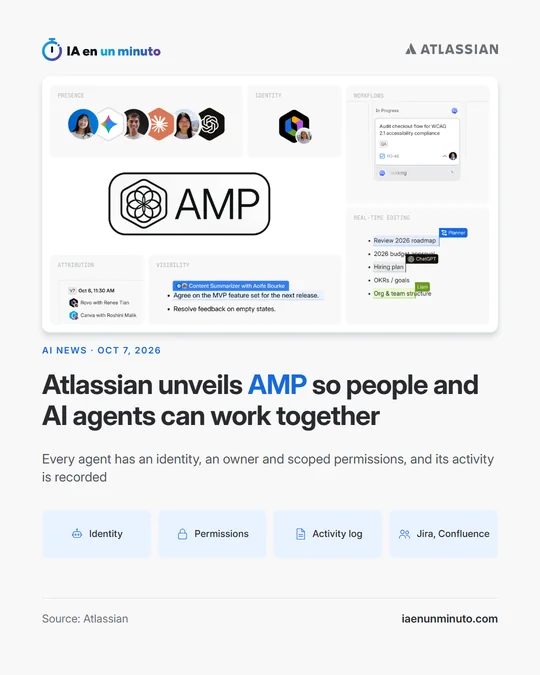
Atlassian has launched AMP so that AI agents can work in Jira, Confluence or Loom with an identity, limited permissions and a person in charge. Every change an agent makes stays visible: its cursor shows up in documents and the system logs who set it going and which data it used. Its new MCP server also cuts token use by up to 25% with Claude, and AI can run only on European Union models.
Atlassian, the company behind Jira and Confluence, unveiled AMP (Agentic Multiplayer Protocol) on October 6 at Team '26 Europe, its annual user conference, held in Amsterdam. It describes AMP as the foundation for how people and AI agents collaborate on its platform: each agent has an identity, scoped permissions, the shared context of the company and work that can be reviewed.
According to a message from Mike Cannon-Brookes on Atlassian's blog, with AMP users can brief an agent with a Loom video, mention it in a Confluence document or debate an approach with it in a Jira comment thread. Tools such as Figma or a code editor can also be connected through MCP, the standard for connecting AI to other applications.
The idea is that agent work does not stay hidden. Every agent has a clear owner and its own profile, and what it does is attributed to it in real time: its cursor appears next to those of the people editing a document, and there is a record of who triggered it and what data it touched. With Agent Sessions, a new Jira capability, agent sessions, both local and cloud ones, connect automatically to the right work items; for now it is in a closed early access program.
On permissions, Cannon-Brookes gives two examples: an HR agent inherits the access of the person prompting it, while a helpdesk agent runs on its own dedicated service account.
At the same conference, Atlassian presented a redesigned version of its MCP server that, according to its internal benchmarks on Claude models, saves up to 25% of tokens compared with the previous version on the same Jira and Confluence work. It is also rolling out AI processing restricted to models hosted in the European Union.
Why it matters · analysis and opinion
An AI agent making changes without leaving a trace is one of the brakes on using it inside a company. Atlassian is trying to have that work treated like any colleague's: with a name, an owner and a history that can be reviewed. For teams that already organise their projects in Jira and Confluence, being able to audit what each agent does may be what they need to trust it with real tasks. Permissions are the most delicate part: an agent inheriting the access of whoever prompts it is convenient, but it means checking carefully what each person can see before turning it on. The option to process AI only with European models also matters for anyone handling data subject to European Union rules.
Official source: Atlassian · Written with the help of AI: how we make the news