Anthropic launches Claude Dashboards and Claude Motion in beta to create data dashboards and animations
IA en un minuto newsroom · Editor: Jon Elgezabal
In 30 seconds
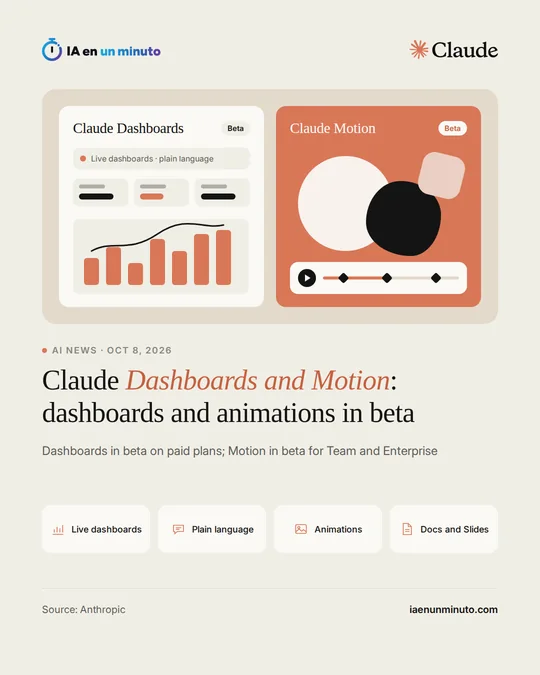
Anthropic is rolling out Dashboards in beta, a Claude feature that builds live dashboards on data from BigQuery, Snowflake or Salesforce from questions asked in everyday words. Motion, limited for now to Team and Enterprise, makes animations out of code that can be tweaked and saved as MP4, with no video model involved. Docs, Slides and Design leave the testing phase and reach every plan, Free included.
Claude can now create data dashboards and animations, both in beta for the moment.
Anthropic launched Claude Dashboards on Thursday as a beta for paid plans. It hooks up to data platforms such as BigQuery, Databricks or Snowflake (Amazon Redshift and ClickHouse are on the list too) or to customer-management tools such as Salesforce, and converts a question asked in plain language into a dashboard that keeps itself up to date as the data changes. Every chart displays the underlying query and the time its data was last updated.
Until now, the company says, anyone with a question about a company's data usually had to open a request with the data team or write SQL queries. Anthropic positions Dashboards for fast, exploratory questions; for deeper analysis, a dashboard can be handed off to analytics tools such as Amplitude, Grafana, Hex, Mixpanel or Sigma. Looker, monday.com and Tableau are to come later.
Claude Motion, a beta for the Team and Enterprise business plans, takes a request and produces an animation that plays like a short video, is editable and downloads as an MP4. As examples, Anthropic mentions making a 30-second explainer video out of a quarterly report, or animating a chart from a presentation. Claude writes the code that animates the text, charts, shapes and images, which means any word, figure or timing can be altered. The company explains that no video generation model is involved, so the result contains neither generated video footage nor people created with AI. The animation can be worked on further in software such as Adobe, Descript, Luma AI or Runway.
Docs, Slides and Design, Anthropic's tools for documents, presentations and design, have also left beta and can be used on every Claude plan, the Free plan included. Anthropic says more than 45 million documents, presentations and designs have been created in Claude since the tools reached all conversations. Among the things they can already do, the company cites editing as a team alongside Claude, sharing outside the organization when the admin permits it, exporting to PowerPoint and PDF with the formatting intact, and making changes from the mobile app.
Claude Design began life at an address of its own, claude.ai/design, and since September 16 has also been available inside any Claude conversation. The standalone version stays open until December 14. Projects will keep working there up to that date, but after it closes the chats and comments left behind will no longer be accessible and the public links to those projects will stop working.
On Enterprise plans, Dashboards and Motion come switched off until the admin enables them, whereas Docs, Slides and Design will be enabled by default on October 15. The announcement mentions no separate price for any of these tools.
Why it matters · analysis and opinion
Until now, getting an answer out of company data meant asking the data team for it or writing the query by hand. Dashboards shortens that path for quick questions, and the fact that each chart shows its query makes it possible to check where every number comes from before sharing it, which is key when the person asking is not an analyst. Motion plays in a different league from video generators, because it animates existing material instead of inventing images, which reduces the risk of misleading content in internal presentations or for clients. Both are still in beta and, on Enterprise accounts, depend on the admin switching them on. Anyone whose data already sits on one of those platforms can start by testing it with questions they already know the answer to, to gauge whether what it returns can be trusted.
Official source: Anthropic · Written with the help of AI: how we make the news