Google unveils a Gemini agent to automate tasks at companies
IA en un minuto newsroom · Editor: Jon Elgezabal
In 30 seconds
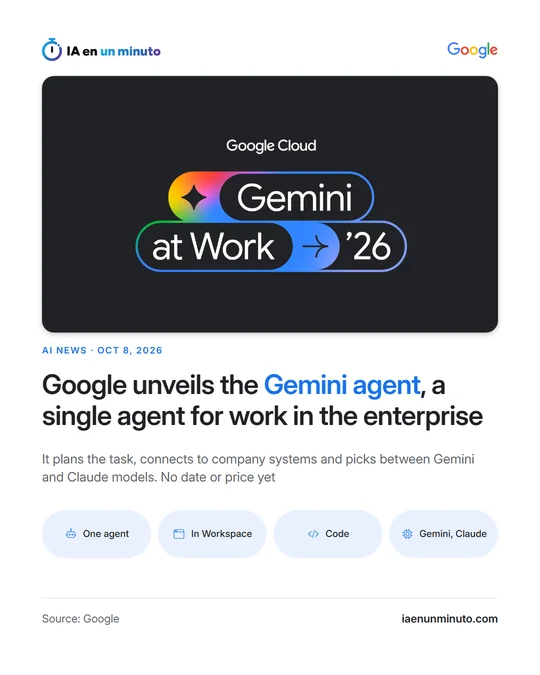
Google Cloud used Gemini at Work 2026 to show off the Gemini agent, built so that a company hands it a goal and gets the work back done. It operates from Gmail, Docs or Slack, links up with Salesforce, Jira or Snowflake and routes each job between Gemini and Claude models depending on the task. Each project can carry a spending limit that pauses it when hit, and Google has not said when it will be available or what it will cost.
Google has presented the Gemini agent, a single agent for work inside companies. From one prompt box it answers questions, produces images and other media, and can write code and run it.
The announcement came from Google Cloud at its Gemini at Work 2026 event. Google says the agent is handed objectives, not step-by-step instructions. It plans the job, draws on tools and on skills (reusable instructions that teach it how each task is done), connects to the company's systems and delivers the finished work in the documents, the email and the coding environments already in use.
The agent runs within Calendar, Chat, Docs, Drive, Gmail, Sheets and Slides. It is also available from Microsoft 365, Slack or the command line, on the web, on iOS and Android phones, and on Windows and Mac computers. Software such as BigQuery, Jira, Salesforce, ServiceNow or Snowflake can be connected to it, as can any MCP (Model Context Protocol) server, whether inside the company network or outside it.
For each task it chooses the best-suited model. At present it mixes Gemini models with Claude models from Anthropic, and Google expects to add others later, both private and open. Tasks lasting hours or days continue in the cloud even if the laptop is shut, and the work can be divided among sub-agents, temporary agents assigned to each part of a task. To control spending, a company can set a per-project cap in the Google Cloud billing console, which the agent monitors in real time. Once the cap is hit, the agent for that project pauses, and one click resumes it.
Google Cloud is also working on versions specialized by industry, each with its own skills and tools. Previews are already open for financial services and legal teams, with government, healthcare and retail to follow soon. The company says almost 80% of Google Cloud customers already use its AI products, and that Gemini Enterprise is used by nearly 90% of Fortune 100 companies.
The announcement gives neither an availability date nor a price for the agent.
Why it matters · analysis and opinion
That Google puts Anthropic's Claude models inside its own agent says a lot about where the market is: companies no longer want to marry a single model, but a place from which to work with several and switch when a better one comes out. For people who live in Gmail, Drive or Slack, the promise is to hand over an outcome instead of dictating steps. What decides a purchase is still missing, though: when it arrives, what it costs and how it performs with a company's real data. The per-project spend cap reveals the concern that weighs most on customers, the bill for agents that work on their own for hours or days. Until there is a price, the useful work is something else: deciding which systems it would be connected to and who would be allowed to grant it access.
Official source: Google Cloud · Written with the help of AI: how we make the news
What does it mean for your business? · analysis and opinion
For a small business that already works in Gmail, Drive and Docs, or in Microsoft 365 and Slack, the idea is appealing: ask for a result, such as a report built from several documents, instead of going step by step. But the story does not say when it arrives or what it costs, so for now there is nothing to buy and nothing to reorganise.
What can be prepared, and it is what we would do, is the ground. An agent that connects to a company's systems and keeps working for hours in the cloud will do exactly what its access allows. Before trying it, it is worth knowing which shared folders are open to everyone, which programs can be connected and who approves each connection.
One detail is also worth noticing: the agent picks the model for each task and already combines Google's with Anthropic's. That helps you avoid depending on a single provider, but it makes it harder to know who handles your data. Our advice, when it reaches your plan, is to ask in writing which models are used, where the information is processed and how you limit what the agent can do without asking. And to start with an internal task, with no customers involved.