IA en un minutoNewsBusiness and products
Google and Constellation sign a 20-year deal to add 890 MW of nuclear capacity to the PJM grid
IA en un minuto newsroom · Editor: Jon Elgezabal
In 30 seconds
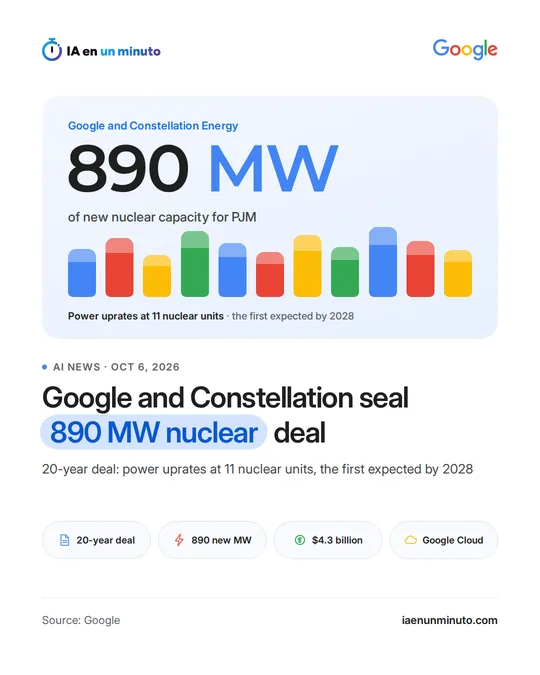
Google will buy power from 890 new nuclear MW for PJM, a grid with 67 million users in the United States, over 20 years. Constellation will put upwards of $4.3 billion into 11 units across Illinois, Pennsylvania and New Jersey, with the first uprate due by 2028. Constellation is also adding a 15-year supply deal for 2,700 MW and five years of work with Google Cloud and Gemini Enterprise.
Google and Constellation Energy have announced a 20-year power purchase agreement to add 890 MW of new nuclear capacity to PJM, the power grid that serves 67 million people in the United States. Constellation will invest more than $4.3 billion to upgrade 11 nuclear units in Illinois, Pennsylvania and New Jersey, and the first uprate is expected by 2028. The companies are also signing a separate 15-year energy supply agreement for 2,700 MW.
Constellation will also use Google Cloud, Google's cloud platform, and Gemini Enterprise, the business version of Gemini, in a five-year technology alliance to optimize asset dispatch and protect critical infrastructure.
Why it matters · analysis and opinion
Google has decided not to wait for spare electricity on the grid: it is committing to buy, for many years, the power that comes from expanding existing nuclear plants, an expansion that Constellation pays for. It says a lot about the market that the AI race is also being played out in long-term power contracts and in works that will not bear fruit for a few years. Whoever can sign something like this secures stable power; whoever cannot competes for what is left on the grid. The deal has another side: Constellation will use Google Cloud and Gemini Enterprise to manage its assets and protect critical infrastructure, so Google is both a customer and a supplier of the power company.
Official source: Constellation Energy · Written with the help of AI: how we make the news