Anthropic expands its verification program for cybersecurity professionals with three tiers of access to Claude
IA en un minuto newsroom · Editor: Jon Elgezabal
In 30 seconds
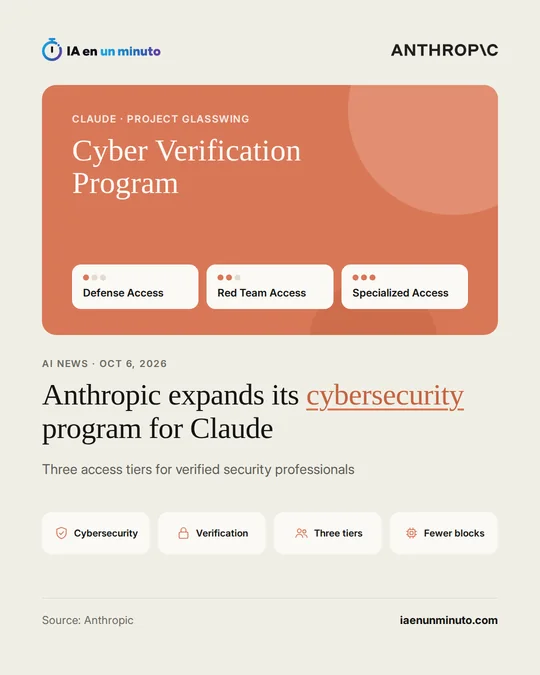
Anthropic has reorganized its Cyber Verification Program into three tiers, giving vetted security specialists its top models with fewer restrictions. It now offers defensive access, a tier that also allows authorized pentesting, and a third for a few organizations probing critical infrastructure, vetted with the US government. Anthropic expects to answer defensive applications within days and pentesting ones within weeks.
More security teams are getting Anthropic's most capable models, and with fewer blocks.
The company has enlarged the Cyber Verification Program, through which verified security professionals obtain access. The program is now split into three tiers. The first covers defensive work, the second adds authorized penetration testing, and the third, which carries the fewest blocks, is reserved for a limited group of organizations that test critical systems such as power grids and are reviewed jointly with the US government.
The models anyone can use block most cybersecurity work as a brake on malicious use. Anthropic expects to answer applications for the defensive tier in a few days, while those for the penetration testing tier will take a few weeks. Organizations that enroll must agree to have their data retained so that misuse can be monitored; later this fall, those that qualify will have the option of keeping that data in a cloud under their own control.
Two earlier initiatives are folded into the program. One is Project Glasswing, under which a group of organizations protecting the most critical software could use Claude Mythos. The other is the CVP itself, which offered Claude Opus and Claude Sonnet with reduced safeguards. Every tier comes with Anthropic's most capable models, among them Claude Mythos 5.1, Claude Opus 5.5 and Claude Sonnet 5.5. The defensive tier accepts security teams from companies, universities and government bodies, operators of critical infrastructure whatever their size (regional hospitals, for example), small security firms, maintainers of open-source projects and individual researchers who have a record of reporting vulnerabilities. Only organizations can join the penetration testing tier, where actions capable of causing physical harm or mass disruption, ransomware deployment among them, remain blocked.
The program can be used on Claude Platform, on Microsoft Foundry and on Vertex AI from Google Cloud. On Amazon Bedrock it is limited to customers who qualify for Enterprise Frontier Safeguards, the solution that will allow data to be kept in a customer-controlled cloud. Organizations already in Project Glasswing go directly to the tier with the fewest blocks.
Why it matters · analysis and opinion
If your security team has run into Claude's blocks while analyzing an attack or a vulnerability, there is now a formal route to ask for fewer restrictions. The first practical step is to choose the tier that matches the actual work, defending your own systems, contracted intrusion testing or critical systems, because each one requires different controls. The second is to read the fine print: Anthropic will retain data to monitor for misuse, which has to be squared with what has been agreed with each client before putting their information through it. Anyone who cannot accept that will have to wait for the own-cloud option or stay with the general models, which keep their brakes.
Official source: Anthropic · Written with the help of AI: how we make the news