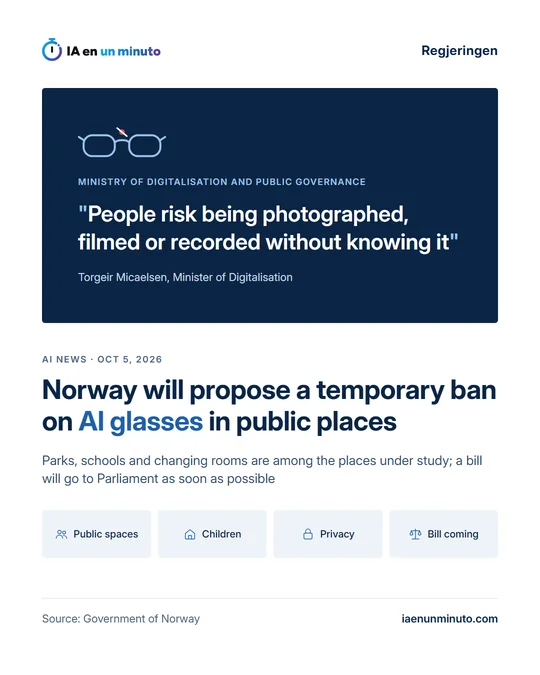
Norway will propose a temporary ban on AI glasses in parks, schools and other public places
IA en un minuto newsroom · Editor: Jon Elgezabal
In 30 seconds
Torgeir Micaelsen, Norway's digitalisation minister, has announced that his government wants a temporary ban on glasses with built-in cameras and microphones in certain places. The options include parks, beaches, schools, gyms with changing rooms and health institutions, although the final list is not settled. The bill will go to the Norwegian Parliament and, while the ban lasts, an expert group will prepare permanent rules.
The Norwegian government has announced that it will propose a temporary ban on artificial intelligence glasses, the ones with a built-in camera and microphone, in certain places. Torgeir Micaelsen, Minister of Digitalisation and Public Governance, announced it on Monday. Exactly where the ban will apply has not yet been decided.
The places the government is considering are busy public spaces, such as parks, beaches, museums, shopping centers and public events; places for children, such as schools, playgrounds and youth clubs; and places where privacy is especially important, such as health institutions and gyms with changing rooms and showers. It is also considering universities and other educational institutions.
"I am worried that powerful new technology is being introduced where people risk being photographed, filmed or recorded without knowing it," Micaelsen said.
The ban is not in force yet: the government will send a bill to the Norwegian Parliament "as soon as possible." It will be temporary because, in the meantime, an expert group will be set up to advise on permanent regulation.
According to The Next Web, the government has made clear it is not planning a total ban: private use will still be allowed, as will use in situations where other people do not risk being recorded without their consent. Nor has it decided yet which devices will be covered: the candidates are glasses that combine a camera with a microphone, glasses that pair a camera with AI features, and other wearable devices that do the same thing.
The same outlet notes that Micaelsen has been in the post for about four weeks and that his predecessor, Karianne Tung, had not supported a ban, according to Norwegian broadcaster TV 2. It also places the announcement in a European context of mounting pressure on camera glasses: a week earlier, the Dutch eyewear chain Hans Anders stopped selling Meta's Ray-Bans in the Netherlands and Belgium.
Correction (12 October 2026): two details, kindergartens and the exceptions for vulnerable groups, have been removed because they could not be checked against any accessible source.
Why it matters · analysis and opinion
Nobody in Norway has to take off their glasses yet: the government has announced a bill, not a rule in force, and has not even settled where it will apply. What is interesting is the approach. Instead of banning the technology in general, it points to specific places where recording without anyone noticing does the most harm, such as changing rooms, health centers, schools or playgrounds. If it goes ahead, it will bind those who wear these glasses, and gyms, clinics and shops could find themselves having to enforce it at their own door. Still to be defined are which devices are covered, how it will be enforced and how long it will last until the expert group proposes permanent regulation. Makers of camera glasses face a market there that could partly close.
Official source: Gobierno de Noruega · Written with the help of AI: how we make the news