A 16-year-old is rescued after following a mountain route planned by Claude
IA en un minuto newsroom · Editor: Jon Elgezabal
In 30 seconds
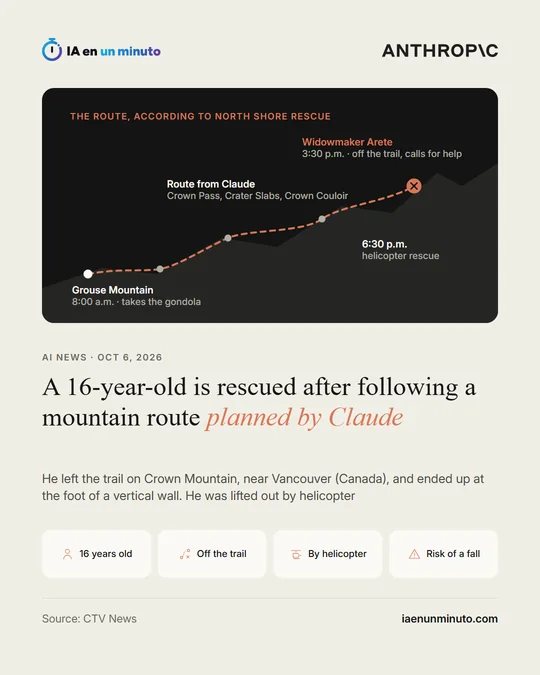
A 16-year-old ended up stuck at the foot of a rock wall on Crown Mountain, in Canada, after trusting an itinerary prepared for him by Claude, from Anthropic. On Saturday, October 3, North Shore Rescue lifted him out with a helicopter that lowered two rescuers above his position. Paul Markey warns that a fall could have been fatal and advises against leaving trip planning to AI.
A 16-year-old boy had to be rescued by helicopter on Saturday, October 3, on Crown Mountain, in British Columbia (Canada), after following a route planned for him by Claude, the AI assistant from Anthropic. The details come from Paul Markey, search manager at North Shore Rescue, the mountain rescue team that was called out at around 3:30 p.m., who spoke to Canadian broadcaster CTV News.
According to Markey, the teenager took the gondola up Grouse Mountain at around 8 a.m. and asked Claude to plan a trip to Crown Mountain. The route sent him down Crown Pass and up through Crater Slabs and Crown Couloir until the instructions led him off the trail. He kept going through difficult terrain and ended up calling for help from the base of the final headwall of the Widowmaker Arete, a rock-climbing route. "A fall would have resulted in significant injury or potentially death," Markey said.
The boy was too close to the vertical wall for the helicopter to get any closer, so two rescuers were lowered to a spot above him. According to North Shore Rescue's task debrief, the crew set up an anchor, and one member was belayed to the teenager and moved him to a suitable extraction point. He was out by around 6:30 p.m.
Markey said the boy had plenty of experience with high-difficulty indoor climbing and was well equipped for the hike and part of the terrain, but this was his first outing in outdoor climbing. Markey added that North Shore Rescue was sent to Crown Mountain three times that weekend, which was very unusual: it had been years since their last call to the area.
"Claude has never been in that specific area, has never been on that route, and has never been in the outdoors," Markey told CTV News, urging people to do their own research, get to know the area and back it up with training and navigation. Speaking to North Shore News, as reported by MobileSyrup, he warned against blindly following routes suggested by AI and recommended hiking apps such as Gaia GPS, CalTopo or AllTrails. MobileSyrup also reports that the boy carried a phone battery pack, a headlamp, hiking boots and a windproof jacket, and that he called for help with his phone.
CTV News's report does not include any comment from Anthropic.
Why it matters · analysis and opinion
Stringing the names of passes and gullies into an itinerary that sounds convincing is within reach of any AI assistant, but that does not guarantee the path leads where it promises. The difference between plausible text and real knowledge of the terrain comes from topographic maps, hiking apps and the experience of people who know the area. For anyone using these tools to prepare any activity with physical risk, the sensible approach is to treat them as a first draft: check the route against a specialist source, tell someone the plan and turn back as soon as the path stops matching what was expected. Companies that build assistants into travel, sport or leisure products have a reminder here of how far their recommendations go and of the importance of saying so clearly.
Source: CTV News · Written with the help of AI: how we make the news