MONAI Label ships version 0.8.6, fixing the critical flaw AI agents found
IA en un minuto newsroom · Editor: Jon Elgezabal

In 30 seconds
MONAI Label, an open program used to label medical images, now has a release, 0.8.6, that closes the critical flaw a set of AI agents discovered unaided and used to take a university server as root, according to Amazon. Amazon maintains nobody knew of it before and connects it, at a moderate confidence level, with someone tied to China. Project MONAI asks operators to upgrade and to check any server that was left exposed.
Project MONAI put out MONAI Label 0.8.6 this Sunday, November 22. The maintainers describe it as a security update, and it closes the critical flaw that, by Amazon's account, a group of AI agents turned up and exploited without being pointed to it. Until now the project's security advisory, dated Wednesday, November 18, listed no corrected version.
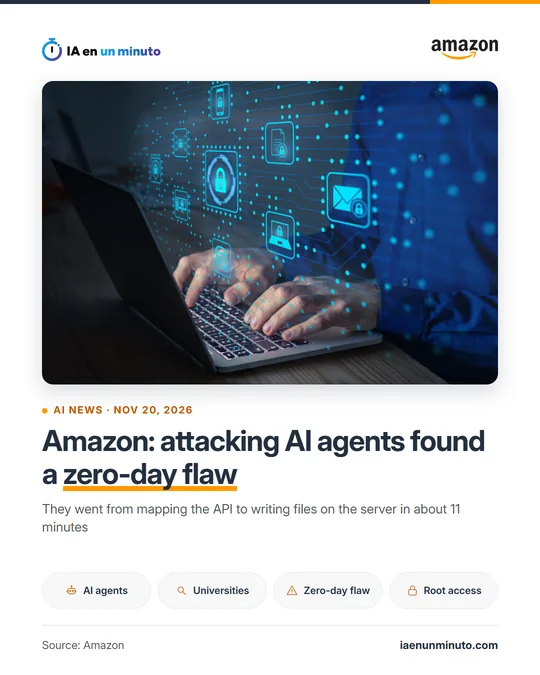
MONAI Label is an open-source application for labeling medical images with AI assistance. According to the report Amazon Threat Intelligence released on Friday, November 20, an attacker coordinated the agents through Cairn, an open-source framework built for security testing, and aimed them at university servers. The agents received a list of IP addresses along with several wordings of one goal, getting command-line access, and needed about 11 minutes to go from exploring the app's API to being able to write arbitrary files on the server. A later session saw them reuse that flaw to execute code and obtain administrator (root) access on a university server. Amazon believes with high confidence that nobody knew about the flaw before, and it attributes the activity, with moderate confidence, to an actor linked to China.
A research note from the Cloud Security Alliance adds that a person stepped in at some moments of the operation and that the confirmed victims are research servers at universities; nothing published so far points to patient data or clinical systems being involved.
The flaw is a path traversal in the functions that upload images and labels: it let a caller place files outside the intended folder, wherever the program itself had write permission. The release notes identify it as CVE-2026-133968 (GHSA-qc22-rmgc-vg94), rated critical, and the new version also closes a second path traversal, this one in session uploads. Both reach back through every release up to 0.8.5, and since authentication ships switched off, anyone able to connect to the server had them within reach. VentureBeat reported that the correction had gone into the source code on October 19, yet 0.8.5 was still the latest published version when Amazon made its report public.
The project asks everyone running a MONAI Label server to upgrade. Whatever the version, it also recommends keeping the server off untrusted networks, turning authentication on and handing roles only to trusted users, and running it under an unprivileged account that can write only to the data folder. Where a server on 0.8.5 or older was reachable from an untrusted network, the advice is to look for unexpected file changes before putting it back into service. Version 0.8.6 drops Python 3.9 and 3.10 and needs Python 3.11 or newer.
Why it matters · analysis and opinion
With the release out, the most awkward part of the case is gone: for weeks the fix existed in the code, yet whoever installed the program the usual way still got the vulnerable version. Now the task is concrete. The first step is finding out whether anyone in the organization runs MONAI Label, common among research and clinical teams whose servers do not always appear in the IT inventory. Next comes upgrading, switching authentication on, closing off internet access and stripping privileges from the account that runs the service. Upgrading is not enough if the server was in plain view: the flaw was exploited before an installable patch existed, so it should be checked as if compromised. The case also shows a change of pace: when the hunt for flaws is done by agents, an application that gets little scrutiny can fall before any public advisory exists.
Official source: Project MONAI (GitHub) · Written with the help of AI: how we make the news