Amazon details how a Chinese-nexus actor's AI agents found and exploited a zero-day flaw on their own
IA en un minuto newsroom · Editor: Jon Elgezabal
In 30 seconds
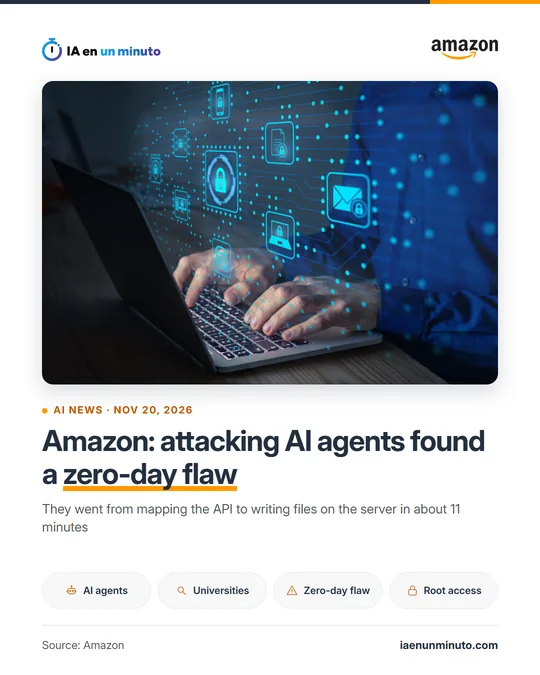
Amazon has documented an attack in which AI agents, with almost no human help, discovered an unknown vulnerability in a medical imaging program and took the server as root. Cairn was the tool driving them, run by an actor Amazon ties to China with moderate confidence, who went after East Asian universities in September. The affected project already has a fix following Amazon's alert.
Amazon Threat Intelligence, Amazon's threat research team, published an investigation on Friday, November 20, into an actor it links to China that set autonomous AI agents loose on servers with very little human input. During that campaign the agents came across a zero-day flaw, meaning a vulnerability with no patch and no earlier warning, in an open-source application, and exploited it to take over a server completely.
On September 10, Amazon spotted a server hosting a copy of Cairn, an open-source framework for AI-driven penetration testing, exposed to the internet with no login, which let its analysts look inside the operation. The records showed a campaign lasting approximately 48 hours from September 8, aimed at IP addresses tied to East Asian universities located outside mainland China. The operator handed the agents a list of targets and variations on a single goal: "obtain shell access." From there, Amazon says, the agents planned, acted and changed course by themselves, with nobody picking each step.
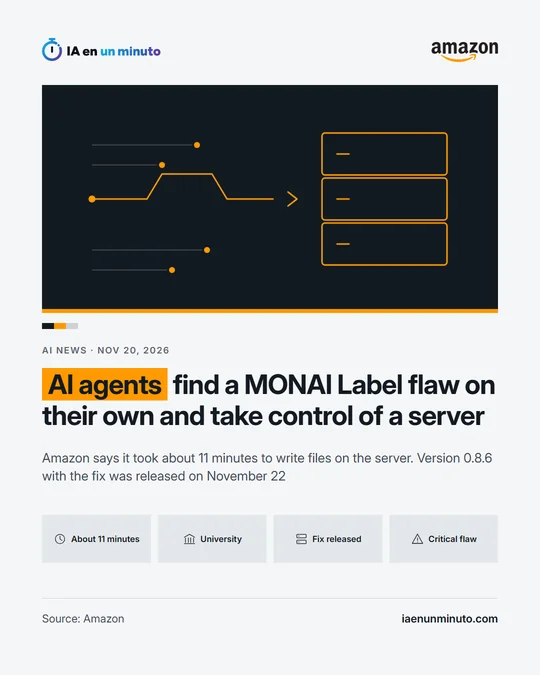
Results varied widely from one operation to the next. The most serious involved a server running an open-source AI application for medical imaging: the agents worked out which framework it used, walked through its API and found a file upload point open to path traversal. Roughly 11 minutes separated the first API mapping from the moment they could write arbitrary files to the server, and they later reused the same flaw to plant a program that opened a reverse shell with root privileges.
Amazon rates it a zero-day with high confidence, since it found no fix, advisory or earlier mention in vulnerability databases; it alerted the project's maintainers, who by Amazon's account have since put out a fix and a security advisory. Its attribution to a Chinese-nexus actor carries moderate confidence and rests on prompts written in Simplified Chinese, timestamps in China Standard Time and the kind of universities chosen. According to Amazon, offensive operations run by agents are already taking place, and defenders should get ready for the speed and persistence they allow.
Why it matters · analysis and opinion
What stands out in this case is not the attacker's sophistication but how little the attacker had to do: a list of addresses, a goal written in plain language and an open-source tool designed for defenders. The work of finding the gap, testing it and exploiting it was done by the agents, and against a program in which nobody had recorded that flaw before. That shortens the margin for any organization with services exposed to the internet, especially if it runs open-source applications that get little scrutiny. A sensible response starts with the basics: knowing what is published, requiring authentication, isolating whatever does not need to be visible and not running services with more privileges than necessary. It also helps to review logs for very fast, methodical probing: the attacker was exposed by leaving their own server open.
Official source: Amazon · Written with the help of AI: how we make the news
What does it mean for your business? · analysis and opinion
The attack Amazon describes targeted universities in East Asia, and the investigation does not mention any victims in Spain or Latin America. Even so, we believe it is relevant to any small business or freelancer with something exposed to the internet: an in-house server, a VPN, remote access via SSH, a network drive or an admin dashboard. These are exactly the services against which the agents tested more than 30,000 credential combinations, using about 80 real usernames pulled from public pages. Those who work only with cloud applications managed by others have fewer open fronts, though not none.
In practice, it is worth making an inventory of what is open to the internet and closing what is not needed, starting with any service without a password: the longest operation, lasting about 16 hours and 148 actions, targeted a Redis database configured without authentication. Our advice is to enable two-factor authentication on the VPN and on remote access, review which employee names are published on the website, and keep installed open-source applications up to date, because in this case the maintainers published a fix on GitHub after Amazon's notice.
The underlying risk is speed: an agent that works in minutes without pausing finishes before anyone reviews an alert. The sensible approach is to set up automatic alerts and blocks for repeated access attempts, which is cheap compared with losing full control of a server.