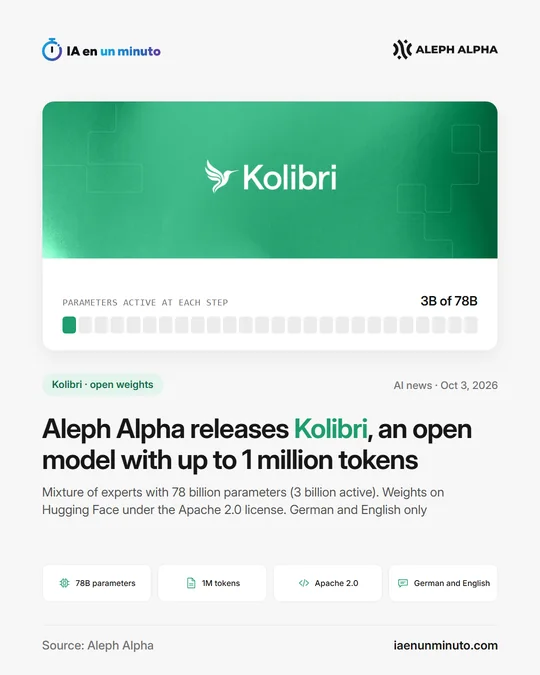
Aleph Alpha launches Kolibri-1, an open model with 78 billion parameters
IA en un minuto newsroom · Editor: Jon Elgezabal
In 30 seconds
German company Aleph Alpha has released Kolibri, a mixture-of-experts model with 78 billion parameters, of which it uses 3 billion per step. Anyone can download the full weights from Hugging Face under Apache 2.0, and it accepts up to 1 million tokens, but it only understands German and English. It needs serious hardware to run, such as one H200 or a pair of 80 GB A100 cards.
German AI company Aleph Alpha released Kolibri, its new language model, on October 3, German Unity Day. The weights are open: the full model can be downloaded from Hugging Face and used under the Apache 2.0 license.
It is a mixture-of-experts model (it splits the work across specialized parts): 78 billion parameters in total, but only 3 billion active at each step. According to the company, this keeps the computing it needs low, although the full model has to be held in memory.
It supports up to 1 million tokens of context (the amount of text it can take into account at once), although the company, in the model card on Hugging Face, recommends staying at about 262,000 or below for efficiency and for complex tasks.
It can reason step by step and call external tools. According to Aleph Alpha, in math, coding and long texts it matches models with up to four times as many active parameters.
It is built for public administration, industry and aerospace, and to run on in-house servers without sending internal data to third parties.
One caveat: it only works in German and English, and it needs powerful hardware: according to its model card on Hugging Face, at least two 80 GB A100 GPUs or one H200, and twice that for the full-precision version.
Why it matters · analysis and opinion
German and English, and nothing else: that limitation decides, before any test, who can get value out of Kolibri. For public bodies, industry or aerospace companies that work in those languages and do not want their data to leave their servers, it is a European, open option with a license that allows use with few strings attached. The architecture is a little deceptive: it activates a small part of the model at each step, which makes computing cheaper, but the whole thing has to sit in memory, which is why it needs high-end GPUs. The comparisons with larger models come from Aleph Alpha itself. Before buying hardware, a rented server is enough to check whether it performs with real documents.
Official source: Aleph Alpha · Written with the help of AI: how we make the news