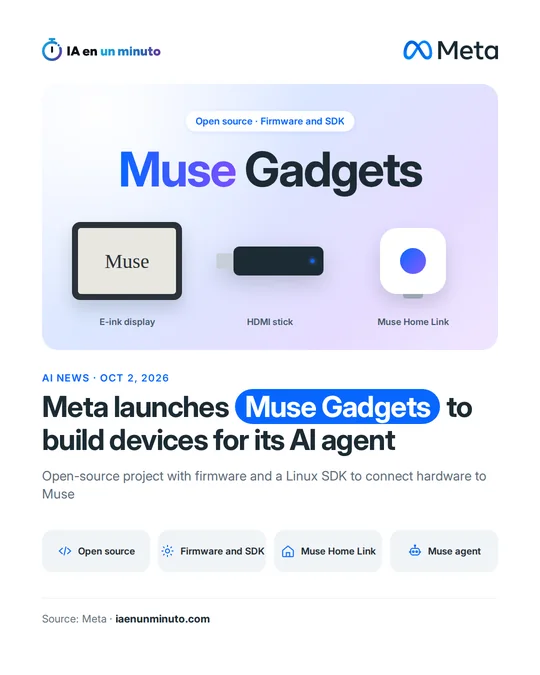
Meta launches Muse Gadgets, an open-source project for building devices that connect to its AI agent
IA en un minuto newsroom · Editor: Jon Elgezabal
In 30 seconds
Meta has open-sourced Muse Gadgets so anyone can build hardware that talks to Muse, its autonomous AI agent. The kit includes a Linux SDK plus the firmware, and it runs on cheap boards such as an ESP32 or a Raspberry Pi. Examples include an HDMI stick for television, an e-ink display and Muse Home Link, which links the agent to the devices in a home.
Meta wants developers to build devices for its AI agent.
The company has launched Muse Gadgets, an open-source project for building devices that connect to Muse, the autonomous AI agent it introduced in early September. It offers a package with firmware and a Linux SDK (the tools for connecting the agent to hardware). The examples it shows include an e-ink display, an HDMI stick for the TV and an accessory with a small touchscreen.
Meta also shows Muse Home Link, its own device powered over USB-C. According to Nat Friedman, head of product at Meta Superintelligence Labs, it lets Muse connect to the home network to communicate with TVs, speakers and other equipment.
On its website, Meta explains that the project works with an ESP32 board or a Raspberry Pi, low-cost boards for electronics hobbyists, and it has opened a Discord community for people building their own devices.
The firmware and SDKs are released under the Apache 2.0 license and, according to the project website, are provided as-is, without warranty. Muse Home Link will be free for people with an active Muse subscription in the United States, only there and limited to one device per subscriber; it ships in October, first come, first served. The TV stick is still listed as coming soon.
The example projects include boards and devices from other brands, such as Raspberry Pi 5, Seeed reTerminal E1002, M5Stack StickS3 and Home Assistant Voice Preview Edition. Meta points out that they are made and sold by other companies and that it does not endorse or warrant them.
Why it matters · analysis and opinion
Muse no longer lives only on a screen. This project lets it out into objects at home and in the office, and Meta leaves the door open for anyone with a cheap board and some skill to build them. The first to benefit are electronics hobbyists and small makers who design connected devices: they get open code to start without asking anyone's permission. Meta's own device, by contrast, is limited to its US subscribers. For other businesses it is still a testing ground, and before plugging an agent into the office network you need to know which data from that equipment would end up on Meta's servers.
Official source: Meta · Written with the help of AI: how we make the news