TrueLayer trials payments made by an AI agent at Papa John's in the UK
IA en un minuto newsroom · Editor: Jon Elgezabal
In 30 seconds
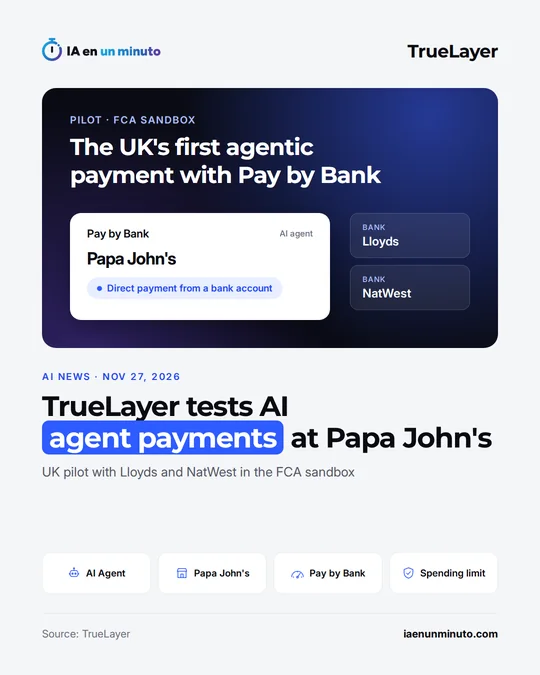
TrueLayer has tried out with Papa John's an automated assistant that settles an order by drawing on the shopper's current account, with no plastic in between. Lloyds and NatWest were among the lenders in the trial, which ran inside the FCA's testing scheme. The person decides beforehand how much may be spent, the bank blocks whatever goes past that, and login details never reach the software.
An AI agent at Papa John's has helped a customer place an order and then paid for it directly out of the linked bank account, although for now only in a pilot.
TrueLayer, a payments network that says it serves more than 30 million people in 22 countries, claims a first: according to the company, no AI agent had previously completed a Pay by Bank payment (a direct payment from a bank account, with no card involved) to a specific UK retailer. Banks including Lloyds and NatWest took part, and the work ran through the sandbox of the FCA, the UK's financial regulator, where the company presented its findings at a showcase on Thursday 26 November. TrueLayer adds that it was also the first time those two banks' variable recurring payment APIs were used with agents.
Spending control is the core of the design. The customer creates a mandate with their bank once and picks the limits, per merchant or per period of time; no AI agent can go beyond them, because the bank reviews each payment and turns down any that exceeds the cap. Approval takes place in the bank's app, so the agent never gets credentials or passwords, and the mandate can be cancelled whenever the customer wants, through the merchant or the banking app.
The announcement gives no availability date for customers. Unite.AI notes that TrueLayer said in July it had been selected for that FCA sandbox, and that the work is still a pilot, not a general launch for consumers.
Why it matters · analysis and opinion
Until now, letting software buy on behalf of a person meant trusting the software itself to follow its instructions, or handing it card details. The pilot moves the checkpoint: the cap is held and enforced by the bank, and the agent can only request the charge. For a retailer, the practical consequence is that paying from a bank account enters the buying conversation without going through the card networks, something TrueLayer openly argues for because it is its business. What decides real-world use is still missing: who answers if the agent orders wrongly within the limit, what the regulator requires of firms that accept these instructions, and when an ordinary customer will be able to use it. Until there is a date, this is a well-built technical demonstration, not a service.
Official source: TrueLayer · Written with the help of AI: how we make the news