Epochal, an AI agent platform that analyzes the internet of the past to predict the future
IA en un minuto newsroom · Editor: Jon Elgezabal
In 30 seconds
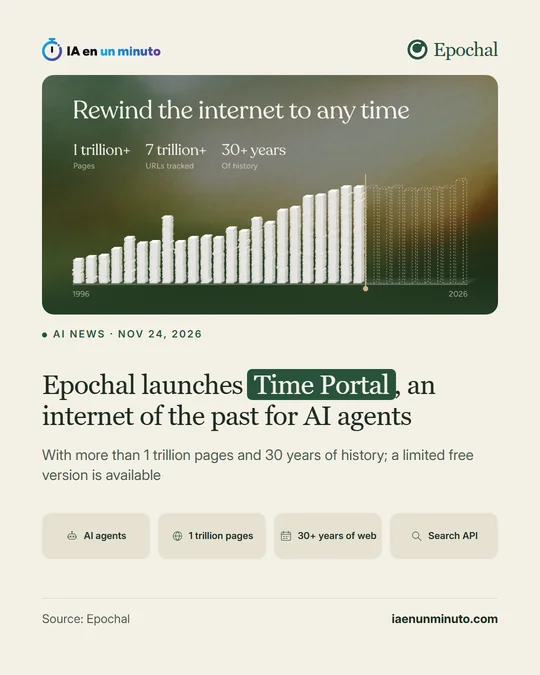
Epochal, a company with three people from xAI's founding team, has introduced Time Portal, an environment where an AI agent browses the internet as it was on a past date. According to Epochal, it can be used to simulate what the agent would have decided at that moment and to ask it for a prediction about what came next. It is offered through three APIs, and a limited free version is available to try it.
Epochal, a company that wants to teach artificial intelligence to predict the future, introduced itself on November 24 on its blog. Behind it are Guodong Zhang, Zihang Dai and Manuel Kroiss, members of xAI's founding team, together with Alex Bocharoff and Frank Luan.
The company argues that current AI models have taken in nearly the whole web without experiencing any of it as it unfolded, since they learn from everything at once and already know how each story ended. Epochal wants them to go through "thousands of yesterdays" day by day, the way people do, which is why it describes its work as a time machine for the internet.
Its first product, which the company says took 90 days, is Time Portal: an environment in which an AI agent searches and browses the internet as it existed on a past date, to simulate how it would have behaved at that moment and then request a forecast of what comes after. According to Epochal, it covers more than a trillion web pages and more than 30 years of internet history, with minute-level precision on the most changeable pages, and a single address can be linked to the different versions it had over time.
It is offered as three APIs: search, page extraction and an isolated environment, a Linux virtual machine whose clock, operating system, packages and web requests are fixed to the chosen date, so the agent does not notice the mismatch. The company suggests uses such as training models, evaluating predictions and testing methods with historical data. To measure how closely it matches reality, it replayed with Time Portal 347 predictions its agents had made live on questions from the Kalshi and Polymarket markets, and says there were no significant differences.
You can start trying it for free, with a limited version, through Epochal's API, console or SDK.
Why it matters · analysis and opinion
The proposal tackles a known problem for anyone evaluating agents that forecast: if the agent can reach today's web, it can find the outcome and the results come out inflated. An environment with the clock, the system and the packages fixed at a date aims to close that leak, which is why it matters for testing methods on historical data before using them for real. What remains to be seen is whether other teams reproduce the absence of differences the company says it measured, and how much it costs to use beyond the limited free version. For a small business it is, for now, a lab tool; it makes more sense for teams that already build analysis or forecasting agents and need a clean way to check them.
Official source: Epochal · Written with the help of AI: how we make the news