UK data regulator warns companies building AI agents for the public
IA en un minuto newsroom · Editor: Jon Elgezabal
In 30 seconds
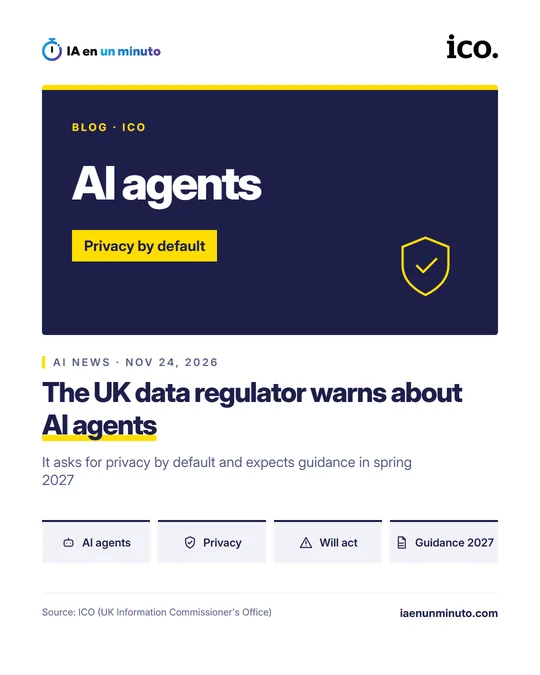
The ICO, the UK data protection regulator, urges companies developing AI agents for the general public to protect privacy from the design stage and to be able to document their legal compliance on a permanent basis. It warns it will act against anyone who launches products without weighing the risks or giving users real controls. Together with the CMA, the British competition body, it has also published advice for people who use an agent.
The Information Commissioner's Office (ICO), the United Kingdom's data protection regulator, published a reminder on its blog on November 24 for companies that develop, integrate or launch AI agents aimed at the general public. It expects them to build in privacy by default from the start and to be able to show, on an ongoing basis, that they comply with British data protection law, with steps to reduce the risk of harm to users. If it sees companies rushing to market without considering privacy risks and without giving users real controls, it says it will act.
The ICO defines these agents as systems that, unlike many chatbots, which mostly answer what they are asked, can take actions on their own on a person's behalf, which may include access to their personal data or that of third parties. It gives the example of an agent that checks someone's contacts to send invitations to an event. It acknowledges benefits when they automate low-risk tasks, such as booking a table at a restaurant, but warns that they will only be sustainable if people trust how their information is used. It also admits that agents raise new questions about how the law applies: data access permissions change dynamically and that can create security risks, and it is hard to be transparent if people do not know what risks the permissions or actions they authorize carry.
The regulator works with other bodies in the Digital Regulation Cooperation Forum (DRCF), which has written to ministers asking companies to contact regulators early and show that they meet their obligations before launching a product. Its public call for evidence on AI agents closed last week and will feed into guidance it expects to publish in spring 2027.
Together with the Competition and Markets Authority (CMA), it has published advice for anyone thinking of using an agent: weigh the pros and cons, because agents can make mistakes and errors are amplified when they act on their own; start with the most limited mode; check what the agent can do without asking and go back to the permission settings regularly; do not connect every account the agent suggests; and check how to switch off, edit or delete what the service remembers.
Why it matters · analysis and opinion
It is best read as an early warning, not a new rule: the ICO creates no obligations, it recalls that the data protection law already in force also applies to agents, and it makes clear that it will look at launches from now on, before its guidance arrives. For anyone who develops or integrates an agent that handles contacts, accounts or third-party permissions, the practical consequence is being able to show, product by product, what data it touches, with what permissions and how the user can limit or withdraw them. Anyone who only uses one in their business gets a useful checklist here: start with the most restricted mode, review permissions regularly and check what the service remembers. That the regulator frames it alongside the competition authority suggests that transparency toward consumers will be a shared criterion.
Official source: ICO · Written with the help of AI: how we make the news
What does it mean for your business? · analysis and opinion
The ICO warning affects anyone who develops, deploys or integrates AI agents for the public in the British market. A small business or a freelancer from Spain or Latin America that sells an app with an agent there, or integrates one into a service for British customers, should take it seriously: the regulator expects data protection turned on by default, to be able to show at all times that it complies with British law, and real controls for the user. For anyone who only uses these tools it does not create obligations, although the recommendations from the ICO and the CMA are useful all the same.
Our advice for a small business that already works with an agent is to start with the most restricted setup, check how much it does without asking for approval and whether each permission is valid for one task or forever, and review the settings every so often. It is worth not linking every account the agent suggests and checking whether the data can be used to train the AI. It takes little time and costs no money.
The risk of not doing it is real: an agent's mistakes multiply when it acts alone, and one that reads the contact list handles data belonging to customers or suppliers. For anyone selling in the United Kingdom, the sensible move is to start preparing the documentation and review the guidance when it comes out, expected between March and May 2027.