New York Bans Toys With Built-In AI Agents for Five Years
IA en un minuto newsroom · Editor: Jon Elgezabal
In 30 seconds
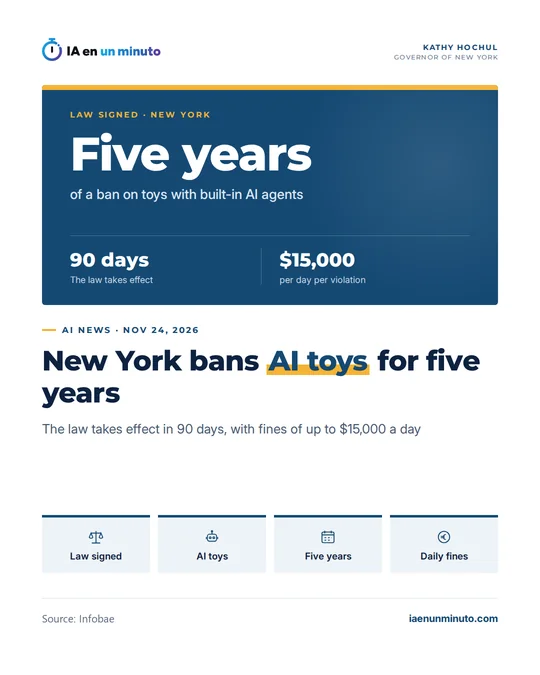
New York has signed a law that bans, for five years, toys with built-in AI that talk with small children, from plush animals to robots. The state attorney general can impose fines of as much as $15,000 per day once the rule starts to apply in 90 days. According to Hochul's statement, in tests by a consumer organization some toys talked about sexual topics.
New York Governor Kathy Hochul signed a law on Tuesday that bans making, distributing and selling toys with built-in AI agents for five years, according to a report by the EFE news agency published by Infobae. The rule targets toys such as plush animals, dolls or robots with AI chatbots that go online to chat with very young children. They reach the market pitched as a learning tool, but they can carry psychological and privacy risks.
The law takes effect in 90 days. The state attorney general's office will be able to impose civil penalties of up to $15,000 a day per violation. Because that date falls after the holiday shopping season, authorities have urged parents to keep the risks in mind when buying.
The governor's statement cites tests by a US consumer organization on toys aimed at children aged 3 to 12. Some talked about sexual topics, helped look for matches and sounded upset when the child walked away. According to the statement, they had few parental controls or none, their safety barriers kept giving way as the chat went on, and some could record the child's voice or scan their face.
The day before, more than 150 organizations and child-protection experts sent an open letter to Amazon and eBay asking them to pull AI toys marketed as "friends" or "emotional companions" until they pass safety tests. In October, Hochul signed another rule on chatbots and minors, and the state already has the RAISE Act, which requires frontier AI companies to register and meet transparency and safety requirements.
Why it matters · analysis and opinion
The law does not ask for better controls: it outlaws the whole category, something unusual for a technology that tends to be regulated with warnings and requirements. It binds whoever makes, distributes or sells these toys in the state, and the pressure also reaches online stores, which a broad group of child-protection organizations wants to pull similar products. The tests the government cites come from a single consumer organization, so they should not be generalized to every toy, but they describe flaws that any company with an AI assistant for minors should review: parental controls, limits that loosen in long conversations and voice recording. Anyone selling AI toys would do well to check those points before a similar rule arrives.
Source: Infobae · Written with the help of AI: how we make the news