OpenAI explains how two amateur astronomers used Codex and Astra to search for exoplanets in public telescope data
IA en un minuto newsroom · Editor: Jon Elgezabal
In 30 seconds
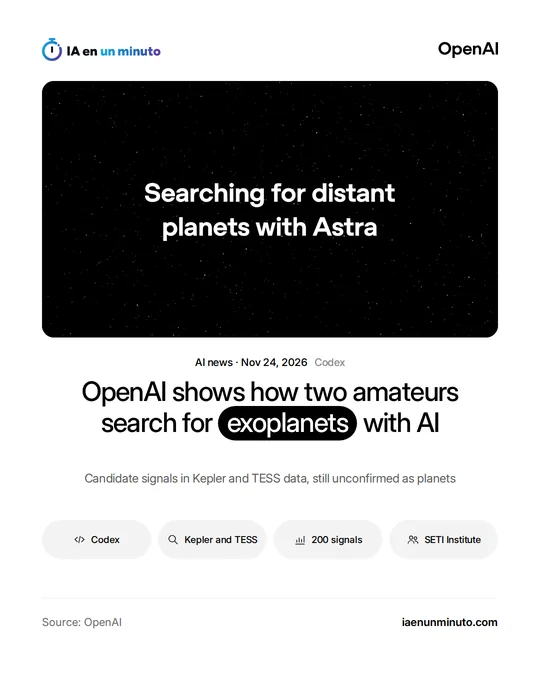
OpenAI says two amateur astronomers have hunted for exoplanets with AI in open telescope data, one with Codex and the other with Astra. Kevin Bond, an engineer at the company, applied his program to Kepler observations and got more than 200 signals, and a SETI Institute astronomer picked out two of them independently. Ethan Byrd has sent a strong candidate to NASA's TESS mission after going through roughly 19 million stars.
OpenAI has published the story of two amateur astronomers who used AI to hunt for exoplanets in public telescope data: Kevin Bond, an engineer at OpenAI itself, and Ethan Byrd, founder of Primitive, an email-infrastructure start-up. They worked separately, and the account comes from the company.
Bond used Codex, OpenAI's programming tool, to compare methods already published, merge them into a search program and check whether changes to the code made it better. He ran it on observations of roughly 100,000 stars from the Kepler telescope, a mission that operated from 2009 to 2018. The program flagged more than 200 signals, 10 of them from planets already confirmed. Two stars stood out, with brightness dips every 13.8 and every 4.8 days, and a SETI Institute astronomer who ran an independent search found both signals. Vishal Gajjar, the institute's associate director for international programs, says in OpenAI's text that the initial checks are "encouraging" and that follow-up observations will tell more.
Byrd tried several AI models and settled on Astra, another AI tool, to analyze data from roughly 19 million stars, with observations from NASA's TESS satellite and other public archives. A first pass produced 49 candidates. He sent one of the strongest to researchers on the TESS mission, where it awaits analysis, and his search is still running.
These are candidates, not confirmed planets. Other explanations, such as two stars crossing, have to be ruled out, and working out what caused the two Kepler signals could take months or years.
Why it matters · analysis and opinion
The case shows AI as a programming assistant more than as a discoverer: Codex and Astra helped compare published methods, build the search program and review signals, while deciding what is worth pursuing stays with astronomers. That Bond's program recovered planets already confirmed is a good sign that it works, though it does not prove it gets new ones right. It is also worth remembering that the account is signed by OpenAI, which employs one of the two protagonists and has an interest in showing off its tools. For a small business or a professional the lesson is practical: with an AI that writes code, an expert from another field can explore open data, but the result is worth only as much as its independent verification.
Official source: OpenAI · Written with the help of AI: how we make the news