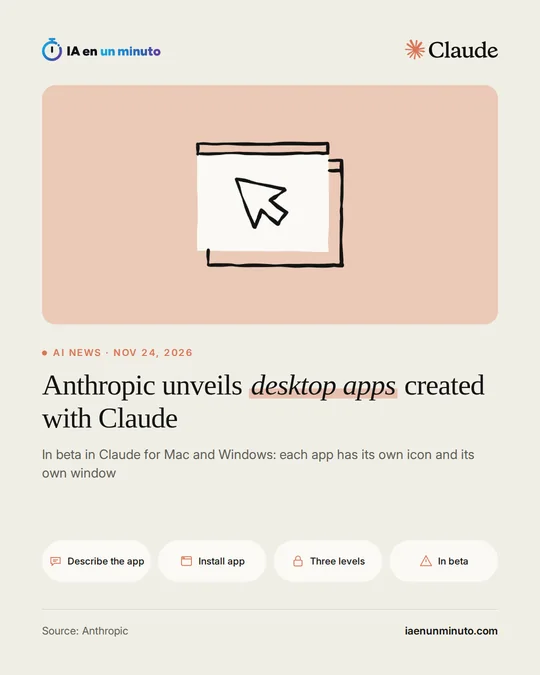
Anthropic lets users install Claude creations as desktop apps for Mac and Windows, in beta
IA en un minuto newsroom · Editor: Jon Elgezabal
In 30 seconds
Anthropic is launching, in beta, a way to pull Claude artifacts out of the conversation and open them as Mac or Windows applications, each with its own icon and window. Each app runs on the user's Claude account and deducts whatever it asks for from the plan's limits. Anthropic reviews none of them before installation and keeps full computer access for the user's own apps.
Anthropic switched on a beta feature called "Install as app" in Claude for Mac and Windows on Tuesday. With it, an artifact, one of the interactive pieces Claude builds in the chat, no longer opens inside Claude and instead gets its own icon and its own window. The company says some people already use artifacts as everyday work tools, such as a meeting-prep page fed by their calendar and email.
Each app can draw on Claude and the user's connectors, refreshes itself when the source artifact is edited, and can send notifications or add items to the menu bar or system tray. Whatever it asks of Claude counts against the plan's usage limits. There is nothing to package or sign: it runs on the Claude account, with no API key or separate login, and you have to be connected to Claude to open it.
There are three permission levels. The basic one allows what a browser would; the next lets an app ask for things like always-on-top windows, global shortcuts or notifications; and full computer access lets it run programs and read, change or delete files without asking each time. A permission covers only the current version: Claude asks again after every update, even your own edits. Full access can only be granted to apps you made or, on Team and Enterprise, to apps from your own organization. Anthropic does not review apps before they are installed.
The feature is rolling out on all plans. On Team it comes switched on, with full access off; on Enterprise it stays off until an owner enables it, and admins on both plans can turn app permissions on or off. HIPAA-ready organizations and hybrid deployments cannot use it, and some artifacts, such as Claude Docs, Slides and Sheets, cannot be installed.
Why it matters · analysis and opinion
An artifact that opens as an app stops being a piece of the conversation and looks more like installed software, with the difference that Claude wrote it from a description. For a small business that is convenient: an internal tool, such as an order tracker, with no developers and no code signing. The risk is on the other side: Anthropic does not review these apps, the permission is renewed after every edit and part of an app can come from another website. With basic permissions the possible harm is that of a browser; with full access, that of any program able to touch files. It is wise to stay at the basic level unless there is a clear need, and on Team and Enterprise to let the administrator decide who can switch it on.
Official source: Anthropic · Written with the help of AI: how we make the news
What does it mean for your business? · analysis and opinion
This affects any small business or freelancer in Spain and Latin America that already uses Claude on Mac or Windows, because the feature is rolling out in beta on all plans. On Team accounts it comes on by default, although with full access turned off; on Enterprise it is turned off until an owner turns it on. Anyone who works with Claude only through the browser, or in organizations that are HIPAA-ready or that use hybrid deployments, cannot use it.
Our advice is to start with something small and useful, such as a dashboard with the orders that need to ship that day or a page that prepares meetings, and to leave it at the basic permission level, which is equivalent to what a website could do in the browser. Before sharing the app with the team, it is worth deciding who can raise the permission level: Team and Enterprise admins can turn off app permissions and full access for the entire organization. The prudent approach is not to grant full access to anything that loads parts from other websites, because those parts can change without Claude asking for permission again.
As for cost, each request the app makes to Claude counts toward the plan's usage limits, so a tool that queries Claude frequently can use up the quota sooner than expected. In addition, the app only opens with an internet connection and with the Claude session signed in, and since this is a beta, it may change.