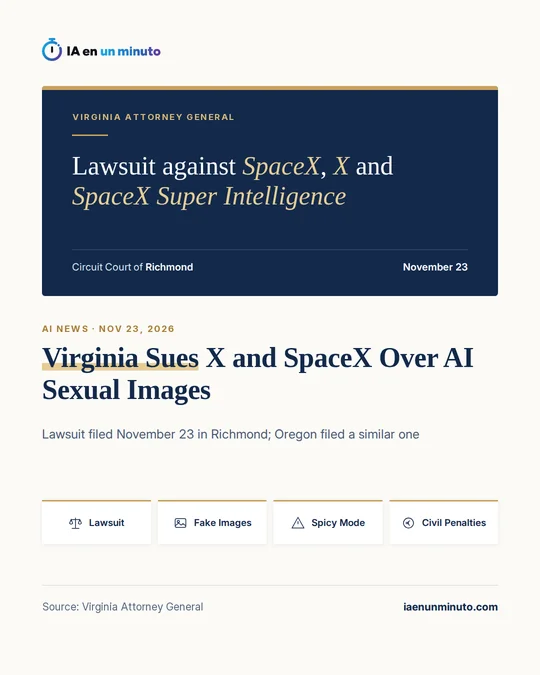
Virginia sues X, SpaceX and the AI company behind Grok over nonconsensual sexual images
IA en un minuto newsroom · Editor: Jon Elgezabal
In 30 seconds
The state of Virginia has sued X, SpaceX and the former xAI, now SpaceX Super Intelligence, over fake sexual images that Grok let people create without the consent of those pictured, some of them minors. Its attorney general says the companies stripped out standard protections and advertised a spicy mode for producing nudes. It seeks $2,500 per intentional violation; the company says it tightened its controls.
Virginia has taken X, SpaceX and the company that develops Grok, the AI chatbot that generates images on X, to court.
On Monday, November 23, Attorney General Jay Jones filed a lawsuit before the Richmond city circuit court over nonconsensual fake sexual images, some of them of minors. According to the complaint, the companies removed safeguards that are standard in the industry and promoted a "spicy mode" built to produce nude images. Oregon filed a separate, similar lawsuit the same day.
The case rests on Virginia's consumer protection law: the state argues the companies gave the impression that safeguards were in place when they were not. It seeks $2,500 for each intentional violation, with the exact number to be proven at trial, plus a court order to stop the violations and the surrender of ill-gotten gains.
Per the complaint, as reported by The Associated Press on FFXnow, Grok received image generation and editing features for all of its users in December 2025. In January the tool triggered a global backlash once it became clear it could create realistic but fake sexualized images of real people, and some researchers warned that several appeared to show minors.
SpaceX Super Intelligence, the current name of xAI, said in a statement quoted by AP that sexual material with minors, genuine or produced by AI, is "abhorrent" and that it acted quickly to tighten its protections when "bad actors" discovered ways to abuse the tool.
Why it matters · analysis and opinion
What stands out is the route chosen: the case invokes no AI-specific law, but consumer protection, which punishes promising safeguards that are then not delivered. That changes the risk for any company offering image generation: what it claims about its safety may end up tested in court against what its product really allows. It is also worth remembering that these are a prosecutor's allegations, not a ruling, and that the company replies that it acted quickly to strengthen its protections. Anyone building a third-party image generator into their business should check which controls it ships with by default and what it promises in public, so as not to offer more than the product delivers.
Official source: Virginia Attorney General's Office · Written with the help of AI: how we make the news