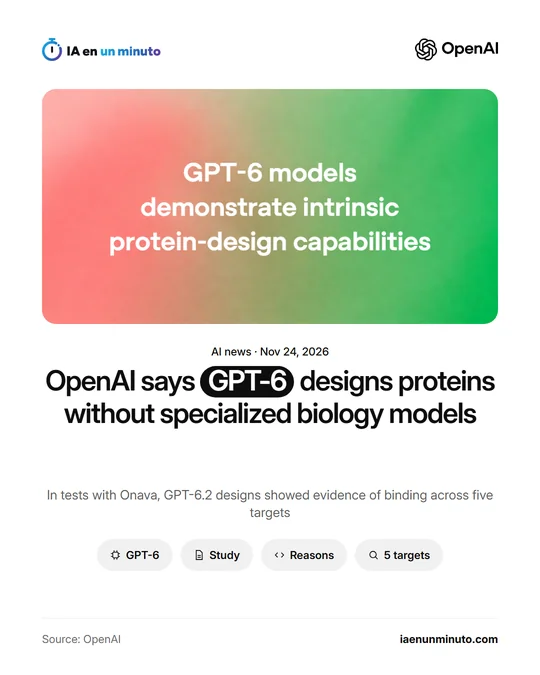
OpenAI says its GPT-6 models design proteins without specialized biology models
IA en un minuto newsroom · Editor: Jon Elgezabal
In 30 seconds
OpenAI maintains that its GPT-6 models can devise new proteins just by reasoning and writing code, with no specialized biology models in the design step. With Onava, its research partner, it took designs from an early build of GPT-6.2 into the lab: 35 of 322 proteins showed evidence of binding to their target. Even so, specialized models were the source of the sequences and of the choice of candidates.
On Tuesday, November 24, OpenAI posted an article and a technical report on its website about protein design with its GPT-6 family of models.
According to the company, the models can come up with new protein shapes and the sequence of amino acids that makes each one up, using only reasoning and general-purpose coding tools, without calling on specialized biology models to produce those designs. Until now, it notes, this work relied on specialized models whose coordination takes considerable expertise. An internal research model matched or outperformed the specialized ones on many of the design tasks; predicting the full structure of a protein, by contrast, remains a clear weak point.
To take the designs into the lab, OpenAI worked with Onava, its research partner. Using a pre-release version of GPT-6.2, it designed small proteins meant to attach to five targets; of 322 tested, 35 (10.9%) came back positive for binding to their target, and each of the five had at least one. The company itself qualifies this: specialized models proposed the amino acid sequences and helped pick the candidates, and its results do not yet show that its models can produce such proteins end to end without that help. It adds that the original RFdiffusion study, a specialized model, reported higher hit rates, although these depend on how much is filtered before testing and on how binding is defined.
In other experiments, GPT-6.2 proposed new sequences for already known proteins and for stretches of antibodies. After candidates were selected with specialized models, many of the redesigns kept binding to their original target; for example, 128 of 182 antibody loop designs (70%) showed signs of binding to the IL-4Rα protein. OpenAI's article does not mention outside review of the study.
Why it matters · analysis and opinion
What is appealing is the underlying promise: a single general model, steered with natural language, in place of several tools that are costly to coordinate today. What was measured, though, is modest: most of the proteins tested showed no binding, OpenAI itself admits it has not yet shown the whole process without specialized help, and it acknowledges that full structure remains a weak point. A sign of binding is also not the same as a useful protein or a drug, and other labs still need to repeat the results with their own means. Anyone working in biotech would do well to follow this and try such tools on narrow tasks, without yet replacing their already validated workflows.
Official source: OpenAI · Written with the help of AI: how we make the news