Z.ai unveils GLM-5.4, its first model with a Loop Transformer architecture
IA en un minuto newsroom · Editor: Jon Elgezabal
In 30 seconds
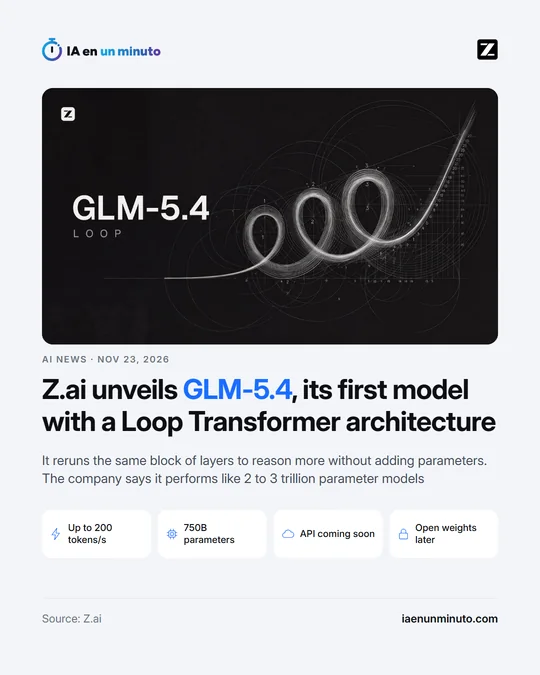
GLM-5.4 is the new flagship model from Z.ai and the first one with a Loop Transformer, a design that passes twice through 28 layers of GLM-5 instead of adding parameters. Z.ai puts it level with models of 2 to 3 trillion parameters and admits it sometimes thinks in loops that run too long. GLM Coding Plan, ZCode and Z.ai Chat already offer it, while the API and the open weights are left for later.
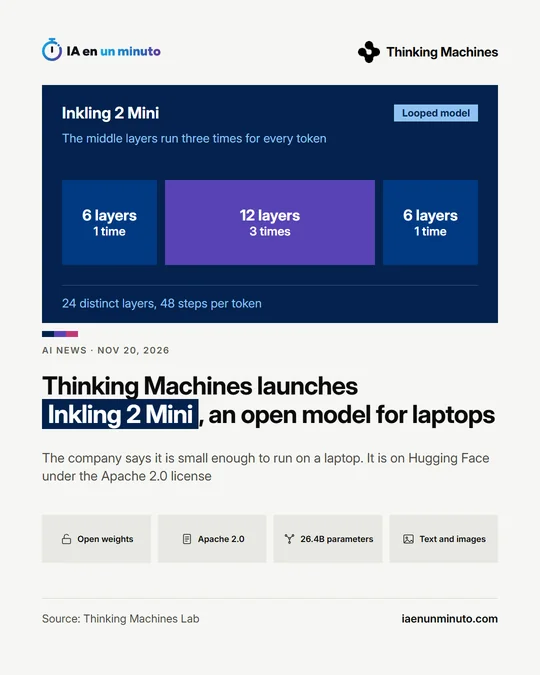
Z.ai has unveiled GLM-5.4, the first of its flagship models built on what it calls a Loop Transformer architecture. The details are in a technical blog post dated November 23. A conventional Transformer goes through each layer once per pass; in this design, a set of layers sharing the same weights is run several times, and every round refines what the previous one produced. The model gains reasoning depth that way while its parameter count stays the same.
Specifically, GLM-5.4 runs 28 layers of GLM-5 two times; that base model has 750 billion parameters. Z.ai says the result is on a par with models that have between 2 and 3 trillion parameters. The company acknowledges the idea is not new, citing the Universal Transformer from 2018, and explains that it did not train a looped model from scratch: it took one that was already pre-trained and kept training it. Before using the approach on its main model, it tested it on base models with 1, 4, 30 and 750 billion parameters. On the 30-billion one, with the parameter count unchanged and roughly 10% more training compute, the looped version improved most on long-context tasks, scientific reasoning and math, and its answers were 10% to 14% shorter on most benchmarks.
Z.ai presents it as the beginning of what it calls "Generalized Coding": using code as the basis for a wider range of work. Its examples include a music video made and edited through code, a six-axis robotic arm modeled in FreeCAD, a full game and an interactive 3D scene. On speed, the company cites as many as 200 tokens per second outside peak hours and between 70 and 80 when demand is highest.
It also admits a limitation: the model is prone to very long thinking loops, although the company says that extended reflection improves accuracy.
GLM-5.4 can already be tried in the GLM Coding Plan (its subscription for coding with AI), in ZCode (its app for coding with several agents) and in Z.ai Chat (its web chat). The API is listed as "coming soon", and Z.ai says the open weights will be released once the necessary safety hardening is finished. The company gives no date for either, and it adds that its next model, considerably larger, will be ready soon.
Why it matters · analysis and opinion
The race for better models has almost always been measured in size: more parameters, more memory and a higher cost of serving them. Z.ai is trying another route, running the same layers more than once, and applies it to its main model instead of leaving it as a small experiment. The equivalence with much larger models is the company's own claim, hard to check from outside while there is no API and no published weights. What a development team can do today is try it in Z.ai's products with its own tasks and watch two things the company itself points out: how long it takes when it gets tangled up thinking, and how speed changes with the time of day. Before building it into a stable workflow, the prudent move is to wait for the API.
Official source: Z.ai · Written with the help of AI: how we make the news