Tencent releases Hy MT3, open translation models in 102 languages that run locally
IA en un minuto newsroom · Editor: Jon Elgezabal
In 30 seconds
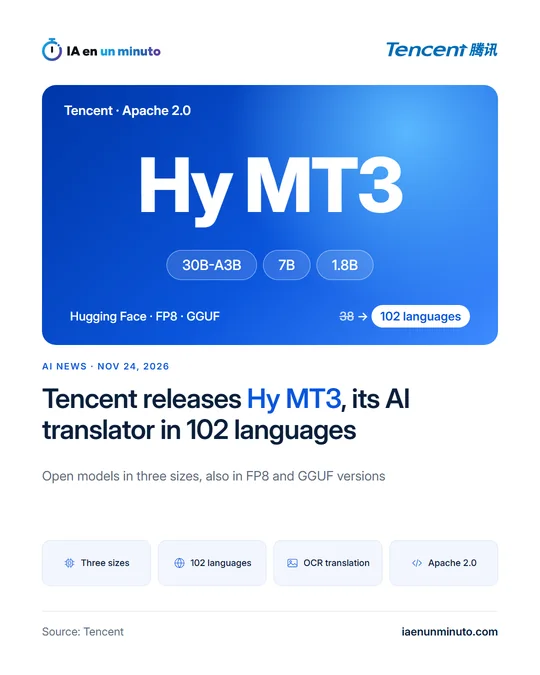
Tencent has put out a new, third round of free-to-download translation tools, built to also work on a personal computer. There are three models of different sizes that cover many more languages than the previous version and are tuned for video game text and images containing writing. The weights carry an Apache 2.0 license and, according to the company's own tests, the smallest one beats commercial translators.
Tencent has released Hy MT3, an open translation AI with versions designed to run locally.
The Chinese company announced it on November 24. It is the third generation of its open-source translation models and is offered as Hy-MT3-1.8B, Hy-MT3-7B and Hy-MT3-30B-A3B, three sizes that each translate into 102 languages, up from 38 in the previous version. Tencent says they are more accurate and follow user instructions better, and the company has optimized them for localizing video games and for translating text in images while correcting OCR (optical character recognition) errors.
According to the tests published by Tencent, the largest model, in non-thinking mode, does better than DeepSeek-V4.1-Flash and Qwen3.8 Max, among others, and the smallest one outperforms commercial translators such as Microsoft Translator in general translation. The outlet GIGAZINE notes that the smallest model can easily run on a laptop. The weights are on Hugging Face (the open-model platform) under the Apache 2.0 license, also in FP8 and GGUF versions, which are easier to run on a personal computer.
Why it matters · analysis and opinion
What changes is where machine translation can live: a small model with open weights can run on your own machine, without sending texts to an outside service, which matters to anyone handling confidential documents or working without a good connection. The caution lies in the comparisons: they are tests published by Tencent itself, not an independent evaluation, and the outlet that reports them simply reproduces them. Anyone who wants to try it can start with the lightest version and check it against real business texts, in the languages they truly need, before depending on it.
Source: GIGAZINE · Written with the help of AI: how we make the news
What does it mean for your business? · analysis and opinion
This news is mainly of interest to small businesses and freelancers who translate often: online stores with product listings in several languages, agencies, law firms with foreign clients, or studios that localize games and apps. For anyone who only translates the occasional email, the translator they already use will still be enough, because setting up their own model requires some technical skill.
The practical advantage is that the text does not have to leave the computer. If contracts, quotes, or customer data are being translated, running the model locally avoids sending them to an external service. Our advice is to start with the smallest version, the 1.8B, in its FP8 or GGUF formats, which according to the report are the easiest to use on a personal computer, and to test it with the company's real documents before switching tools. It is worth comparing the result with the usual translator in the languages that are actually used, because the tests cited were published by Tencent itself.
The cost of trying it out is low: the weights can be downloaded from Hugging Face and the license is Apache 2.0, although it is wise to read its terms before integrating it into a product or a service for customers. The main risk lies in trusting it without checking: for legal, medical, or sensitive commercial texts, someone who is fluent in the language should always review the translation before sending it.