Anthropic expands MCP: server usage guides enter public beta and background tasks reach general availability
IA en un minuto newsroom · Editor: Jon Elgezabal
In 30 seconds
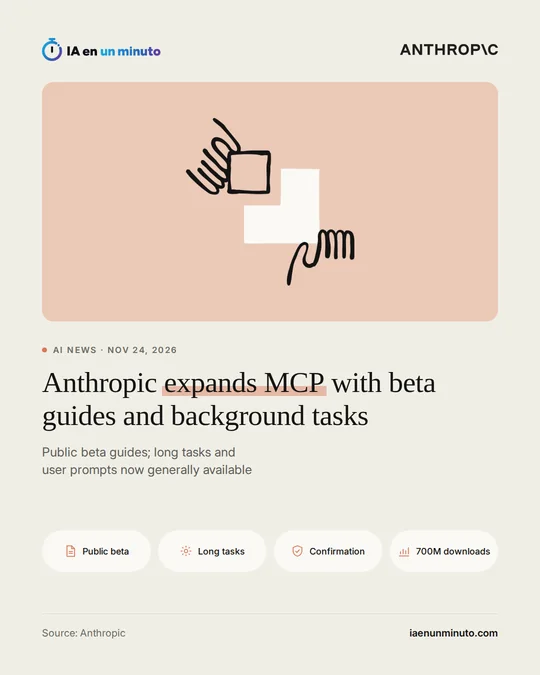
Anthropic is adding features for long jobs to MCP, the protocol that links agents to tools and data. Servers will be able to offer Claude their own guides, in public beta, while background tasks and requests for the user's confirmation are now generally available on Pro, Max and Ultra. File Uploads, for sending files to servers, is still to come.
MCP, an open standard that lets AI agents plug into the systems holding a company's data, is getting features aimed at longer jobs. Anthropic introduced it two years ago.
On Tuesday, November 24, Anthropic announced that Skills over MCP, which lets servers publish usage guides next to their tools, has entered public beta in Claude and in Claude Code, the company's coding assistant. Pro, Max and Ultra subscribers get it switched on by default; on Team it needs an administrator's approval, and Enterprise will follow soon. Anthropic names Shopify, HubSpot and Atlassian as examples.
Two other features, Tasks and Elicitation, have moved to general availability for Pro, Max and Ultra in Claude and Claude Code, with a rollout to Team and Enterprise under way. Tasks handles long jobs that run in the background; Elicitation lets a server stop midway to ask the user for information or approval. A third, File Uploads, is due soon: it will let PDFs, spreadsheets and images reach servers without passing through the context window.
Anthropic's examples: ZoomInfo uses Tasks for account and contact research that once took several prompts, and Supabase confirms costs before creating a paid project. As an Elicitation case, GitHub makes users type a repository's name before an agent deletes it.
The company also says MCP's SDKs are downloaded more than 700 million times a month and that Claude has over 10,000 connectors. All of this belongs to the open MCP specification and its extensions, so any compatible client can use a server that supports it, not just Claude.
Why it matters · analysis and opinion
Until now, a tool call had to finish before the assistant could carry on, and any sensitive action depended on how each server chose to raise a flag. With background tasks and confirmation requests, long-running work and human sign-off become standard parts of the protocol rather than each vendor's workaround. That changes the question for a company evaluating agents: it is no longer only what the agent can do, but at which moments it stops to ask. The guides that servers publish, still in beta, promise fewer mistakes when using third-party tools. They are worth trying on narrow tasks, checking which steps require confirmation before connecting systems that hold money or customer data.
Official source: Anthropic · Written with the help of AI: how we make the news
What does it mean for your business? · analysis and opinion
This affects freelancers and small businesses in Spain and Latin America that pay for Claude on the Pro, Max, or Ultra plans and have it connected to services such as Shopify, HubSpot, Atlassian, or GitHub through MCP connectors. On Pro, Max, and Ultra, Skills over MCP guides come enabled by default; on Team, an administrator needs to enable them, and on Enterprise they have not arrived yet. Tasks and Elicitation are also still rolling out to Team and Enterprise. Anyone who uses Claude only to write or summarize text, without connecting it to other applications, will barely notice a difference.
In practice, it is worth reviewing which connectors the company account has active and removing the ones that are not used. On the Team plan, the sensible approach is for the administrator to first test the guides with a single service, for example the online store, before opening them up to the whole team, because they are still in beta. With Elicitation, our advice is to always read the confirmation screen before accepting: it is designed precisely for spending and deletions, and approving it without looking cancels out that protection.
The main risk is delegating long background jobs without supervising them. An agent with access to the store, the CRM, or a database can make changes that are hard to undo, so we believe the sensible approach is to give it only the essential permissions and keep a copy of the data before any task that modifies it.